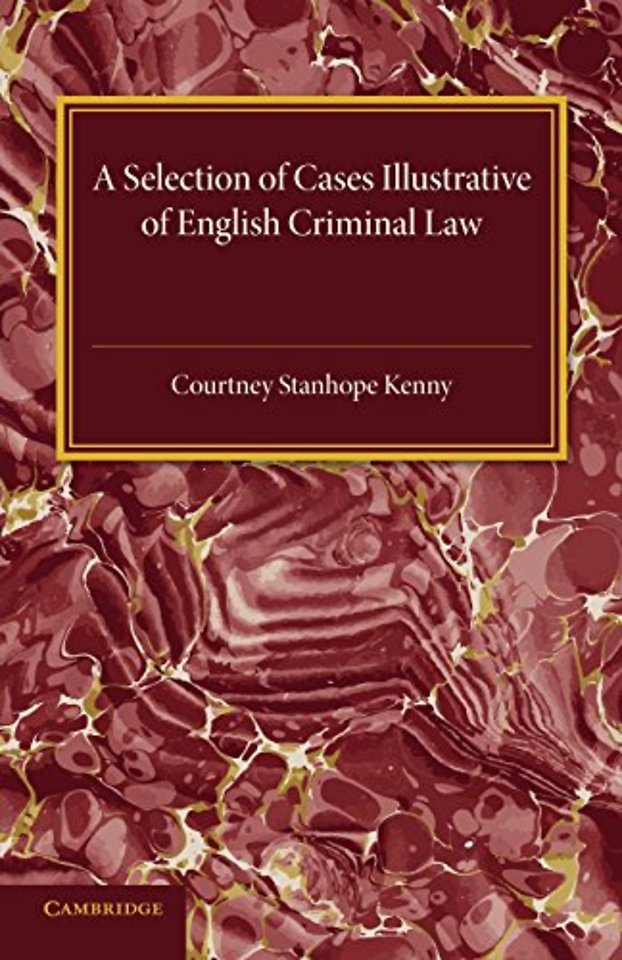
Courtney Stanhope Kenny
Cambridge University Press
e druk, 2015
9781107455733
A Selection of Cases Illustrative of English Criminal Law
Specificaties
Paperback, 610 blz.
|
Engels
Cambridge University Press |
e druk, 2015
ISBN13: 9781107455733
Rubricering
Levertijd ongeveer 8 werkdagen
Samenvatting
First published in 1935 as the eighth edition of a 1901 original, this book contains an overview of a number of cases that established important precedents in English and early American criminal law. The topics covered include the general principles of criminal liability, the definition of crimes such as manslaughter, forgery and suicide, and the various modes of legal proof. This detailed book will be of value to anyone with an interest in British or American legal history.
Specificaties
ISBN13:9781107455733
Taal:Engels
Bindwijze:Paperback
Aantal pagina's:610
Uitgever:Cambridge University Press
Inhoudsopgave
Part I. General Principles of Criminal Liability; Section I. The Distinction between Civil and Criminal Wrongs; Section II. The Mental Element in Criminal Liability; Section III. Modes of Participation in a Crime; Section IV. Inchoate Crimes; Part II. Definitions of Particular Crimes; Section I. Suicide; Section II. Murder and Manslaughter: 1. The external act; 2. The mental state in murder; 3. The mental state in manslaughter; Section III. Homicides that Are Not Crimes; Section IV. Statutory Offences against the Person; Section V. Common Assaults; Section VI. Malicious Offences against Property; Section VII. Burglary: 1. The place; 2. The breaking; 3. The entry; 4. The intent; Section VIII. Housebreaking; Section IX. Forgery: 1. The instrument; 2. The forging; 3. The intent; Section X. Larceny: 1. Taking; 2. Carrying away; 3. Appropriation by bailees; 4. The subject-matter; 5. The value; 6. The ownership; 7. The claim of right; 8. The intention; Section XI. Embezzlement: 1. Who is a servant?; 2. What can be embezzled?; 3. Proof of appropriation; Section XII. False Pretences: 1. The mere pretence; 2. The obtaining; 3. The right obtained; 4. The subject-matter of the right; Section XIII. Receiving Stolen Goods; Section XIV. High Treason; Section XV. Treason-Felony; Section XVI. Riot and Unlawful Assembly; Section XVII. Conspiracy; Section XVIII. Perjury; Section XIX. Bigamy; Section XX. Libel; Part III. Modes of Legal Proof; Section I. Presumptions; Section II. The Burden of Proof; Section III. Evidence: 1. The importance of observing the rules of evidence; 2. The relevancy of evidence; 3. Leading questions; 4. Proof of writings; 5. Hearsay; 6. Confessions; 7. Evidence of character; 8. Privilege; 9. Accomplices; 10. Discrediting a witness; Index.