Gratis boekenweekgeschenk bij een bestelling boven de €17,50 (geldt alleen voor Nederlandstalige boeken)
,

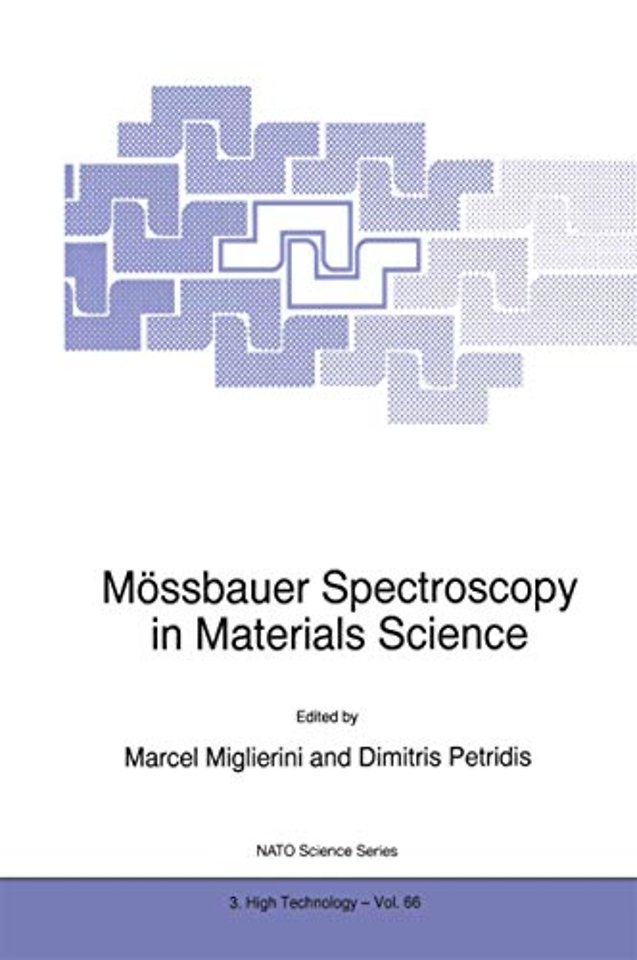
Mössbauer Spectroscopy in Materials Science

Specificaties
Gebonden, 432 blz. | Engels
Springer Netherlands | 1999e druk, 1999
ISBN13: 9780792356400
Rubricering
Springer Netherlands 1999e druk, 1999 9780792356400
€ 120,99
Levertijd ongeveer 8 werkdagen

Samenvatting

Material science is one of the most evolving fields of human activities. Invention and consequent introduction of new materials for practical and/or technological purposes requires as complete knowledge of the physical, chemical, and structural properties as possible to ensure proper and optimal usage of their new features. In order to understand the macroscopic behaviour, one has to search for their origin on a microscopic level. A good deal of microscopic information can be obtained through hyperfine interactions. Mossbauer spectroscopy offers a unique possibility for hyperfine interaction studies via probing the nearest order of resonant atoms. Materials which contain the respective isotope as one of the constituent elements (e.g., iron, tin, ... ) but also those which even do not contain them can be investigated. In the latter case, the probe atoms are incorporated into the material of interest in minor quantities (ca. 0.1 at. %) to act as probes on a nuclear level. This Workshop has covered the most evolving topics in the field of Mossbauer spectroscopy applied to materials science. During four working days, SO participants from 19 countries discussed the following areas: Chemisliy, Mineralogy and Metallurgy, Artificia/~y Structured Materials, Nanosized Materials and Quasicrvstals. and Experimental Techniques and Data Processing. A total of 42 contributions (30 keynote talks) reviewed the current state of art of the method, its applications for technical purposes, as well as trends and perspectives. A total of 39 papers are included in the present volume. Applications in Chemisfr\'.

Specificaties

ISBN13:9780792356400
Taal:Engels
Bindwijze:gebonden
Aantal pagina's:432
Uitgever:Springer Netherlands
Druk:1999

Inhoudsopgave

Preface. I: Chemistry, Mineralogy and Metallurgy. Structure and Properties of Tin-Doped Metal Oxides; F.J. Berry, et al. The Kinetics of the Phase Transition in Ferrosilicon System; Ö. Helgason, et al. Fluoride-Ion Conductors Derived from the Fluorite Type; G. Dénès, et al. The Ba1-xSnxCl1+yF1-y Solid Solution; A. Muntasar, G. Dénès. The Mechanism of beta-Fe2O3 Formation by Solid-State Reaction between NaCl and Fe2(SO4)3; R. Zboril, et al. Mössbauer Measurements of Solid Solutions (FexCr1-x)2O3, 0 Spectrometry Applied to Iron-Based Nanocrystalline Alloys I; J.-M. Grenèche, M. Miglierini. Mössbauer Spectrometry Applied to Iron-Based Nanocrystalline Alloys II; M. Miglierini, J.-M. Grenèche. Radiation Damage of Nanocrystalline Materials; J. Sitek, J. Degmová. Disordered Nanocrystalline Fe-Sn Alloys; E.P. Yelsukov, et al. Iron Nanoparticles in X and Y Zeolites Prepared by Reduction with NaN3; K. Lázár, et al. Quasielastic Mössbauer Scattering in Stable Icosahedral AI-Cu-Fe Quasicrystals; R.A. Brand, et al. IV: Experimental Techniques and Data Processing. Quasi-Elastic Processes Studied by Methods Sensitive to the Momentum and Energy Transfer; K. Ruebenbauer. Synchrotron Mössbauer Reflectometry in Materials Science; D.L. Nagy, et al. Site Preference of57Co in Fe-Si Alloys after Grain Boundary Diffusion; O. Schneeweiss, et al. High Pressure Mössbauer Spectroscopy; M.P. Pasternak, R.D. Taylor. The Challenge of an Automatic Mössbauer Analysis; P.A. de Souza Jr., V.J. Garg. Evaluation of Experimental Data: Lineshape and Goodness of Fit; G. Pedrazzi, et al. CONFIT for WINDOWS® 95; T. Žák. YAP:Ce Scintillation Detector for Transmission Mössbauer Spectroscopy; M. Mašhláň, et al. The Mössbauer Spectrometer as a Virtual Instrument; M. Mašhláň, et al. Calib
€ 120,99
Levertijd ongeveer 8 werkdagen

Rubrieken

    Personen

      Trefwoorden

        Mössbauer Spectroscopy in Materials Science