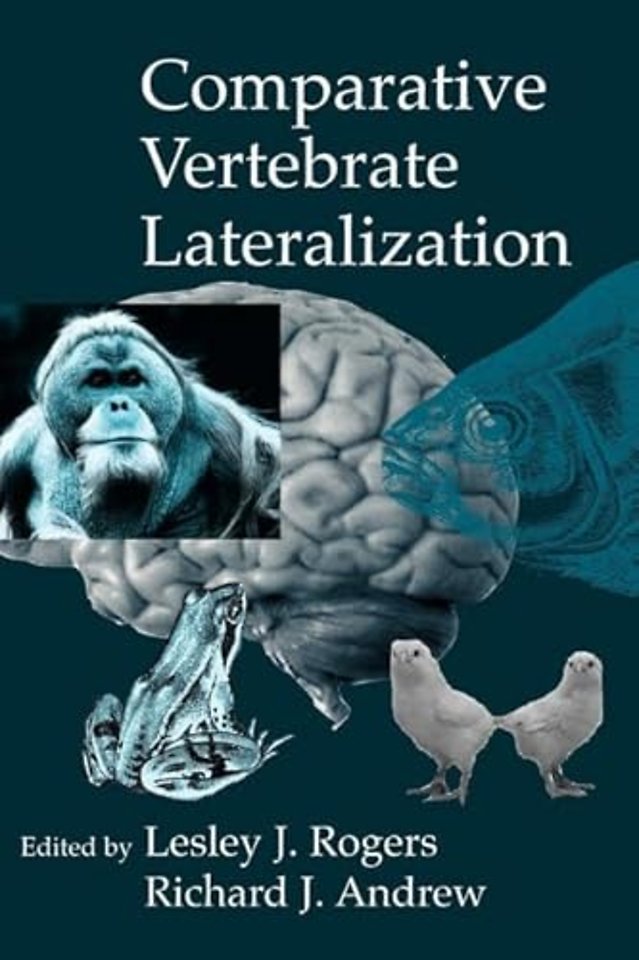
,

Comparative Vertebrate Lateralization

Specificaties
Gebonden, 672 blz. | Engels
Cambridge University Press | e druk, 2002
ISBN13: 9780521781619
Rubricering
Cambridge University Press e druk, 2002 9780521781619
€ 193,75
Levertijd ongeveer 8 werkdagen

Samenvatting

No longer viewed as a characteristic unique to humans, brain lateralization is considered a key property of most, if not all, vertebrates. This field of study provides a firm basis from which to examine a number of important issues in the study of brain and behaviour. This book takes a comparative and integrative approach to lateralization in a wide range of vertebrate species, including humans. It highlights model systems that have proved invaluable in elucidating the function, causes, development, and evolution of lateralization. The book is arranged in four parts, beginning with the evolution of lateralization, moving to its development, to its cognitive dimensions, and finally to its role in memory. Experts in lateralization in lower vertebrates, birds, non-primate mammals, and primates have contributed chapters in which they discuss their own research and consider its implications to humans. The book is suitable for researchers, graduates and advanced undergraduates in psychology, neuroscience and the behavioral sciences.

Specificaties

ISBN13:9780521781619
Taal:Engels
Bindwijze:Gebonden
Aantal pagina's:672

Inhoudsopgave

Preface; Introduction; Part I. Evolution of Lateralization: 1. How ancient is lateralization? G. Vallortigara and A. Bisazza; 2. The earliest origins and subsequent evolution of lateralization R. J. Andrew; 3. The nature of lateralization in tetrapods R. J. Andrew and L. J. Rogers; 4. Advantages and disadvantages of lateralization L. J. Rogers; Part II. Development of Lateralization: 5. Behavioral development and lateralization R. J. Andrew; 6. Factors affecting the development of lateralization in chicks C. Deng and L. J. Rogers; 7. Ontogony of visual lateralization in pigeons O. Güntürkün; 8. Development of laterality and the role of the corpus callosum in rodents and humans P. E. Cowell and V. H. Denenberg; 9. Posture and laterality in human and nonhuman primates: asymmetries in maternal handling and the infant's early motor asymmetries E. Damerose and J. Vauclair; Part III. Cognition and Lateralization: 10. Evidence of cerebral lateralization from senses other than vision R. J. Andrew and J. A. S. Watkins; 11. Facing an obstacle: lateralization of object and spatial cognition G. Vallortigara and L. Regolin; 12. Laterality of communicative behaviors in nonhuman primates: a critical analysis W. D. Hopkins and S. F. Carriba; 13. Specialized processing of primate facial and vocal expressions: evidence for cerebral asymmetries D. J. Weiss, A. A. Ghazanfar, C. T. Miller and M. D. Hauser; Part IV. Lateralization and Memory: 14. Memory and lateralized recall A. N. B. Johnston and S. P. R. Rose; 15. Memory formation and brain lateralization R. J. Andrew; Epilogue; Appendix; Index.
€ 193,75
Levertijd ongeveer 8 werkdagen

Rubrieken

    Personen

      Trefwoorden

        Comparative Vertebrate Lateralization