,

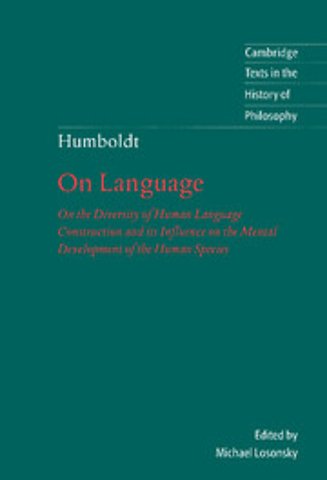
Humboldt: 'On Language'

On the Diversity of Human Language Construction and its Influence on the Mental Development of the Human Species

Specificaties
Gebonden, 342 blz. | Engels
Cambridge University Press | e druk, 1999
ISBN13: 9780521660891
Rubricering
Cambridge University Press e druk, 1999 9780521660891
Onderdeel van serie Cambridge Texts in t
€ 123,91
Levertijd ongeveer 8 werkdagen

Samenvatting

Wilhelm von Humboldt's classic study of human language was first published in 1836, as a general introduction to his three-volume treatise on the Kawi language of Java. It is the final statement of his lifelong study of the nature of language, exploring its universal structures and its relation to mind and culture. Empirically wide-ranging - Humboldt goes far beyond the Indo-European family of languages - it remains one of the most interesting and important attempts to draw philosophical conclusions from comparative linguistics. This 1999 volume presents a translation by Peter Heath, together with an introduction by Michael Losonsky that places Humboldt's work in its historical context and discusses its relevance to contemporary work in philosophy, linguistics, cognitive science, and psychology.

Specificaties

ISBN13:9780521660891
Taal:Engels
Bindwijze:Gebonden
Aantal pagina's:342

Inhoudsopgave

1. Distribution and cultural connection of the Malayan races; 2. General consideration of the course of man's development; 3. The same, continued; 4. Effects of exceptional mental power; 5. Conjoint action of individuals and nations; 6. The same, continued; 7. Transition to closer consideration of language; 8. Form of languages; 9. Nature and constitution of languages as such; 10. Sound-system of languages; 11. Inner linguistic form; 12. Combination of sound with inner linguistic form; 13. The procedure of language more fully explained; 14. Isolation, inflection and agglutination of words; 15. Verbal unity more closely examined; 16. Accent; 17. Incorporative system of languages; 18. Congruence of sound-forms in languages with grammatical requirements; 19. Main division of languages, according to the purity of their formative principle; 20. Character of languages; 21. Power of languages to evolve felicitously from one to another; 22. Retrospect on the course of the inquiry so far; 23. Nature and origin of less perfect language-structure; 24. The Chinese language; 25. Whether the polysyllabic language-structure has evolved from the monosyllabic.
€ 123,91
Levertijd ongeveer 8 werkdagen

Rubrieken

    Personen

      Trefwoorden

        Humboldt: 'On Language'