
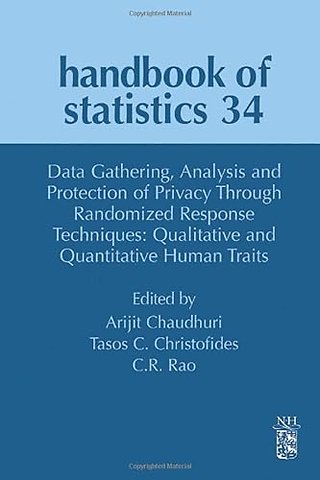
Data Gathering, Analysis and Protection of Privacy Through Randomized Response Techniques: Qualitative and Quantitative Human Traits
Specificaties
Gebonden, blz.
|
Engels
Elsevier Science |
e druk, 2016
ISBN13: 9780444635709
Rubricering
Onderdeel van serie
Handbook of Statistics
Levertijd ongeveer 8 werkdagen
Samenvatting
Data Gathering, Analysis and Protection of Privacy through Randomized Response Techniques: Qualitative and Quantitative Human Traits tackles how to gather and analyze data relating to stigmatizing human traits. S.L. Warner invented RRT and published it in JASA, 1965. In the 50 years since, the subject has grown tremendously, with continued growth. This book comprehensively consolidates the literature to commemorate the inception of RR.
Specificaties
ISBN13:9780444635709
Taal:Engels
Bindwijze:Gebonden
Uitgever:Elsevier Science
Serie:Handbook of Statistics
Inhoudsopgave
<p>1. Review of Certain Recent Advances in Randomized Response Techniques<br>T.J. Rao and CR Rao <br>2. The background and genesis of Randomized Response Techniques<br>Arijit Chaudhuri<br>3. How Randomized Response Techniques Need Not be Confined to Simple Random Sampling but Liberally Applicable to General Sampling Schemes<br>Arijit Chaudhuri<br>4. The Classical Randomized Response Techniques<br>Tasos Christofides<br>5. On the estimation of correlation coefficient using scrambled responses<br>Sarjinder Singh<br>6. Admissible and Optimal Estimation in Finite Population Sampling under Randomized Response Models <br>Samindranath Sengupta<br>7. A mixture of true and randomized responses in the estimation of the number of people having a certain attribute<br>Andreas Quatember<br>8. Estimation of complex population parameters under the randomized response theory<br>Lucio Barabesi<br>9. An Efficient Randomized Response Model Using Two Decks of Cards Under Simple and Stratified Random Sampling<br>Sally Abdelfatah and Reda Mazloum <br>10. Software for Randomized Response Techniques<br>Maria del Mar Rueda<br>11. Post-Stratification based on the Choice of Use of a Quantitative Randomization Device<br>Oluseun Odumade<br>12. Variance Estimation in Randomized Response Surveys<br>Arun Kumar Adhikary<br>13. Behavior of some scrambled randomized response models under simple random sampling, ranked set sampling and Rao-Hartley-Cochran designs<br>Carlos N. Bouza-Herrera<br>14. Estimation of a Finite Population Variance under Linear Models for Randomized Response Designs<br>Parimal Mukhopadhyay<br>15. Randomized Response and New Thoughts on Politz-Simmons Technique<br>T.J. Rao<br>16. Optional Randomized Response: A Critical Review<br>Raghunath Arnab<br>17. A Concise Theory of Randomized Response Techniques for Privacy and Confidentiality Protection<br>Tapan Nayak<br>18. A review of regression procedures for randomized response data, including univariate and multivariate logistic regression, the proportional odds model and item response models<br>Peter van der Heijden<br>19. Eliciting Information on Sensitive Features: Block Total Response Technique and Related Inference<br>Bikas Kumar Sinha<br>20. Optional Randomized Response Revisited<br>Rahul Mukerjee<br>21. Measures of respondent privacy in randomized response surveys<br>Mausumi Bose<br>22. Cramer-Rao lower bounds of variance for estimating two proportions and their overlap by using two-decks of cards <br>Sarjinder Singh<br>23. Estimating a finite population proportion bearing a sensitive attribute from a single probability sample by Item Count Technique<br>Purnima Shaw<br>24. Surveying a varying probability Adaptive Sample to Estimate Cost of Hospital Treatments of sensitive diseases by RR Data Gathering<br>Sanghamitra Pal<br>25. Estimation of means of two rare sensitive characteristics: Cramer-Rao lower bound of variances<br>Sarjinder Singh<br>26. Estimating sensitive population proportion by generating randomized response following direct and inverse hypergeometric distribution<br>Kajal Dihidar<br>27. Incredibly efficient use of a Negative Hypergeometric distribution in randomized response Techniques<br>Sarjinder Singh<br>28. Comparison of Different Imputing Methods for Scrambled Responses<br>Sarjinder Singh<br>29. On an indirect response model<br>V R. Padmawar</p>