Hüseyin Kocak
Springer New York
2e druk, 1988
9780387969183
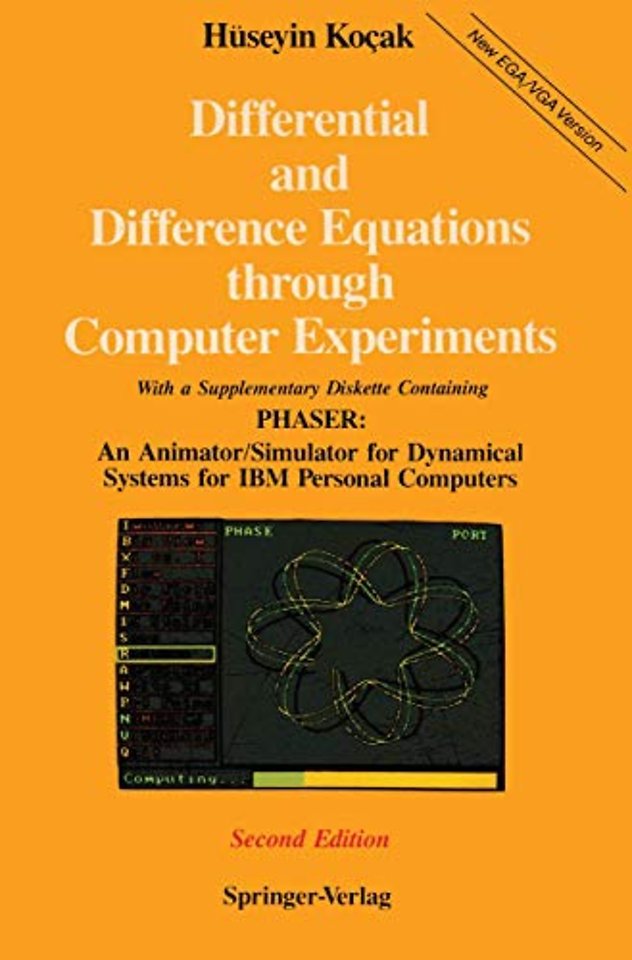
Differential and Difference Equations through Computer Experiments
With Diskettes Containing PHASER: An Animator/Simulator for Dynamical Systems for IBM Personal Computers
Specificaties
Paperback, 224 blz.
|
Engels
Springer New York |
2e druk, 1988
ISBN13: 9780387969183
Rubricering
Levertijd ongeveer 8 werkdagen
Samenvatting
Phaser is a sophisticated program for IBM personal com-
puters, developed atBrown University by the author and some
of his students, which enables usersto experiment with
differential and difference equations and dynamical systems
in an interactive environment using graphics. This book
begins with a brief discussion of the geometric inter-
pretation of differential equations and numerical methods,
and proceeds to guide the student through the use of the
program. To run Phaser, you need an IBM PC, XT, AT, or PS/2
with an IBM Color GRaphics Board (CGB), Enhanced Graphics
Adapter (VGA). A math coprocessor is supported; however, one
is not required for Phaser to run on the above hardware.
Specificaties
ISBN13:9780387969183
Taal:Engels
Bindwijze:paperback
Aantal pagina's:224
Uitgever:Springer New York
Druk:2
Inhoudsopgave
I: Mathematical Synopsis.- 1. What is a Differential Equation?.- 1.1. Systems of Differential Equations.- 1.2. Geometrical Interpretation.- 1.3. Higher Order Equations.- 1.4. Non-autonomous Equations.- 2. Numerical Methods.- 2.1. Overview of Numerics.- 2.2. A Comparison of Algorithms.- 2.3. Practical Guidelines.- 3. What is a Difference Equation?.- 3.1. One-dimensional Difference Equations.- 3.2. Application: Calculating $$\sqrt{2}$$.- 3.3. Systems of Difference Equations.- 3.4. Planar Poincare Maps.- II: Handbook of PHASER.- 4. Learning to Use PHASER.- 4.1. The Startup Screen Layout.- 4.2. Interacting with PHASER.- 5. Lessons with PHASER.- Lesson 1. In and out of PHASER.- Lesson 2. Changing menus.- Lesson 3. Direction field.- Lesson 4. Changing views.- Lesson 5. Graphing variables.- Lesson 6. Initial conditions and parameters.- Lesson 7. Making transcripts for demonstrations.- Lesson 8. Browsing through the library.- Lesson 9. Entering your equations.- Lesson 10. Euler vs. Runge-Kutta.- Lesson 11. Stair step diagrams.- Lesson 12. Three-dimensional graphics.- Lesson 13. Advanced graphics: A 4D example.- Lesson 14. Planar sections and Poincare maps.- Lesson 15. Grand finale: Demo.- 6. Reference Guide to Menus.- 6.1. The NUMERICS Menu.- 6.2. The UTILITIES Menu.- 6.3. The VISUALAID Menu.- 6.4. The Graphical VIEWS.- III: Library of Equations.- 7. Differential Equations.- 7.1. One-dimensional Equations cubicld.- 7.2. Two-dimensional Equations linear2d, pendulum, vanderpol, predprey, saddlenod, pitchfork, transcrit, hopf, dzerol, dzero2, dzero3, hilbert2, hilbert4, averfvdp, gradient.- 7.3. Three-dimensional Equations lorenz, linear3d, vibration, bessel, euler, laguerre, legendre, forcevdp, forcepen, mathieu, forceduf, rossler, zeroim, silnikov, silnikov2.- 7.4. Four-dimensional Equations harmoscil, kepler, r3body, henheile, coplvdpl, coplvdp2, couplosc, reson21.- 8. Difference Equations.- 8.1. One-dimensional Equations logistic, dislinld, discubic, newton, tent, singer, mod, arnold.- 8.2. Two-dimensional Equations dislin2d, gauss, quadl, quad2, henon, lozi, dellogis, dispprey, bounball, anosov, Cremona, icremona, gingerman.- 8.3. Three-dimensional Equations dislin3d, act.- What remains to be done?.- Appendix A: PHASER Quick Reference.- Appendix B: Library of Equations.- References.