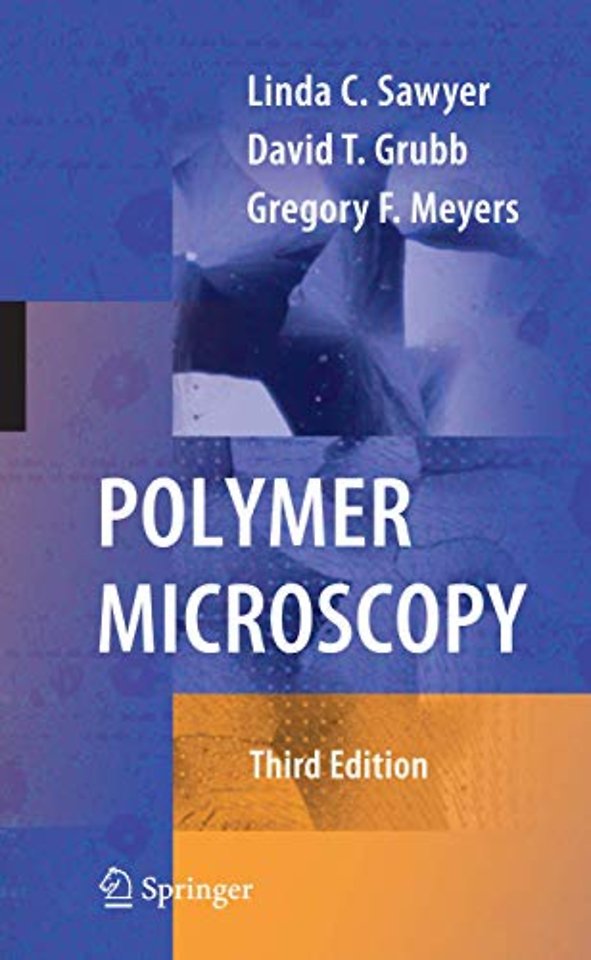
Linda Sawyer,
David T. Grubb,
Gregory F. Meyers
Springer New York
3e druk, 2008
9780387726274
Polymer Microscopy
Specificaties
Gebonden, 540 blz.
|
Engels
Springer New York |
3e druk, 2008
ISBN13: 9780387726274
Rubricering
Levertijd ongeveer 8 werkdagen
Samenvatting
This extensively updated and revised Third Edition is a comprehensive and practical guide to the study of the microstructure of polymers. It is the result of the authors' many years of academic and industrial experience. Introductory chapters deal with the basic concepts of both polymer morphology and processing and microscopy and imaging theory. The core of the book is more applied, with many examples of specimen preparation and image interpretation leading to materials characterization. Emerging techniques such as compositional mapping in which microscopy is combined with spectroscopy are considered. The book closes with a problem solving guide.
Specificaties
ISBN13:9780387726274
Taal:Engels
Bindwijze:gebonden
Aantal pagina's:540
Uitgever:Springer New York
Druk:3
Inhoudsopgave
<P>Introduction to polymer morphology. -Polymer materials. -Introduction. -Definitions. -Polymer morphology. -Amorphous polymers. -Semicrystalline polymers. -Liquid crystalline polymers. -Polymer processes. -Others that could be incorporated into 3rd ed.include: blown film processing; coating process, multi-layer extrusion. -Extrusion of fibers and films. -Extrusion and molding. -Polymer characterization. -General techniques. -Microscopy techniques. -Specimen preparation methods. -Applications of microscopy to polymers. -New microscopy techniques. -Fundamentals of microscopy. -Introduction. -Lens - imaging microscopes. -Scanning - imaging microscopes. -Optical microscopy (OM). -Introduction </P>
<P></P>
<P>Objective lenses
<P></P>
<P>Imaging modes
<P></P>
<P>Measurement of refractive index
<P></P>
<P>Polarized light
<P></P>
<P>Scanning electron microscopy (SEM)
<P></P>
<P>Introduction
<P></P>
<P>Imaging signals
<P></P>
<P>SEM optimization
<P></P>
<P>Special SEM types
<P></P>
<P>-FESEM is now standard</P>
<P>Transmission electron microscopy (TEM)
<P></P>
<P>Imaging in the TEM
<P></P>
<P>Diffraction techniques
<P></P>
<P>Phase contrast and lattice imaging
<P></P>
<P>Scanning probe microscopy (SPM)
<P></P>
<P>Introduction
<P></P>
<P>Family of techniques figure, with emphasis on force microscopy</P>
<P>Imaging Modes
<P></P>
<P>a) Contact mode, incl. force modulation and friction;b) Tapping and Phase;c) Non- contact, incl. EFM and MFM</P>
<P>SPM Probes
<P></P>
<P>Microscopy of radiation sensitive materials
<P></P>
<P>condense this section, and/or move to new artifacts or issues topic </P>
<P>SEM operation
<P></P>
<P>Low dose TEM operation
<P></P>
<P>Analytical microscopy
<P></P>
<P>X-ray microanalysis
<P></P>
<P>X-ray analysis in the SEM vs AEM
<P></P>
<P>Elemental mapping
<P></P>
<P>EELS
<P></P>
<P>Electron energy loss in conjuntion with morphology (TEM)</P>
<P>Quantitative microscopy
</P>
<P>Calibration
<P></P>
<P>-describe needs for SPM - 3 dimensional calibration of distance; force calibration</P>
<P>Image processing
<P></P>
<P>Stereology and image analysis
<P></P>
<P>-description of advantages of phase image contrast by SPM as input for IA </P>
<P>Dynamic microscopy
<P></P>
<P>Stages for dynamic microscopy
<P></P>
<P>Include SPM tensile and hot stages </P>
<P>Imaging theory
<P></P>
<P>Imaging with lenses
<P></P>
<P>Basic optics
<P></P>
<P>Resolution
<P></P>
<P>Electron diffraction
<P></P>
<P>Contrast mechanisms
<P></P>
<P>Illumination systems
<P></P>
<P>Imaging by scanning electron beam
<P></P>
<P>Scanning optics
<P></P>
<P>Beam - specimen interactions
<P></P>
<P>Image formation
<P></P>
<P>Imaging by scanning a solid probe
<P></P>
<P>-complete re-write, simplifying equations for important concepts</P>
<P>Contact modes
<P></P>
<P>Force interactions, Image and contrast formation </P>
<P>Intermittent contact mode and phase imaging
<P></P>
<P>Force interactions, all the stuff about cantilever dynamics, linear vs. non-linear and practical aspects of contrast formation </P>
<P>Non-contact modes
<P></P>
<P>Long range forces and image formation in EFM and MFM</P>
<P>Artifacts due to probe-surface interaction
<P></P>
<P>Polarizing microscopy
<P></P>
<P>Polarized light
<P></P>
<P>Anisotropic materials
<P></P>
<P>Polarizing microscopy
<P></P>
<P>Radiation effects
<P></P>
<P>- will consider moving to a topic on artifacts </P>
<P>Effect of radiation on polymers
<P></P>
<P>Radiation doses and specimen heating
<P></P>
<P>Effects of radiation damage on the image
<P></P>
<P>Noise limited resolution
<P></P>
<P>Image processing
<P></P>
<P>Specimen preparation methods
<P></P>
<P>Simple preparation methods
<P></P>
<P>Optical methods
<P></P>
<P>SEM methods
<P></P>
<P>TEM methods
<P></P>
<P>SPM methods
<P></P>
<P>Polishing
<P></P>
<P>Microtomy
<P></P>
<P>Peelback of fibers/films for SEM
<P></P>
<P>Microtomy for OM
<P></P>
<P>MIcrotomy for SEM
<P></P>
<P>Microtomy for SPM
<P></P>
<P>Microtomy for TEM
<P></P>
<P>Ultrathin sectioning
<P></P>
<P>Ultrathin cryosectioning
<P></P>
<P>Staining
<P></P>
<P>Introduction
<P></P>
<P>Osmium tetroxide
<P></P>
<P>Ebonite
<P></P>
<P>Chlorosulfonic acid
<P></P>
<P>Phosphotungstic acid
<P></P>
<P>Ruthenium tetroxide
<P></P>
<P>Silver sulfide
<P></P>
<P>Mercuric trifluoroacetate
<P></P>
<P>Iodine
<P></P>
<P>Summary
<P></P>
<P>Etching
<P></P>
<P>Introduction
<P></P>
<P>Plasma and ion etching
<P></P>
<P>Solvent and chemical etching
<P></P>
<P>Acid etching
<P></P>
<P>Summary
<P></P>
<P>Replication
<P></P>
<P>Simple replicas
<P></P>
<P>Replication for TEM
<P></P>
<P>Conductive coatings
<P></P>
<P>Coating devices
<P></P>
<P>Coatings for TEM
<P></P>
<P>Coatings for SEM and SPM
<P></P>
<P>Artifacts
<P></P>
<P>Gold decoration
<P></P>
<P>Yielding and fracture
<P></P>
<P>Fractography
<P></P>
<P>Fracture: standard physical testing
<P></P>
<P>In situ deformation
<P></P>
<P>in-situ AFM tensile stages</P>
<P>Crazing
<P></P>
<P>thinning in crazed zones </P>
<P>Freezing and drying methods
<P></P>
<P>Simple freezing methods
<P></P>
<P>Freeze drying
<P></P>
<P>Critical point drying
<P></P>
<P>Freeze fracture-etching
<P></P>
<P>
<P></P>
<P>Polymer applications
<P></P>
<P>Include in each of those specific SPM examples </P>
<P>Fibers
<P></P>
<P>Introduction
<P></P>
<P>Textile fibers
<P></P>
<P>Problem solving applications
<P></P>
<P>Industrial fibers
<P></P>
<P>Films and membranes
<P></P>
<P>Introduction
<P></P>
<P>Model studies
<P></P>
<P>Industrial films
<P></P>
<P>Thin Films for Electronics
<P></P>
<P>Abrasion Resistant Coatings
<P></P>
<P>Flat film membranes
<P></P>
<P>Hollow fiber membranes
<P></P>
<P>Engineering resins and plastics
<P></P>
<P>Introduction
<P></P>
<P>Semicrystalline polymers
<P></P>
<P>Amorphous polymers
<P></P>
<P>Extrudates and molded parts
<P></P>
<P>Multiphase polymers
<P></P>
<P>Failure analysis
<P></P>
<P>Image analysis of impact modified resins
<P></P>
<P>Composites
<P></P>
<P>Introduction
<P></P>
<P>Composite characterization
<P></P>
<P>Fiber composites
<P></P>
<P>Particle filled composites
<P></P>
<P>Carbon black filled rubber
<P></P>
<P>Nanocomposites
<P></P>
<P>Emulsions and adhesives
<P></P>
<P>Introduction
<P></P>
<P>Latexes
<P></P>
<P>Wettability
<P></P>
<P>Adhesives and adhesion
<P></P>
<P>Liquid crystalline polymers
<P></P>
<P>Decrease level of detail in this section</P>
<P>Introduction
<P></P>
<P>Optical textures
<P></P>
<P>Solid state structures
<P></P>
<P>High modulus fibers
<P></P>
<P>Structure-property relations in LCPs
<P></P>
<P> </P>
<P> </P>
<P>New techniques in polymer microscopy
<P></P>
<P>This will be an entirely new chapter</P>
<P>Introduction
<P></P>
<P>Optical microscopy
<P></P>
<P>Confocal scanning microscopy
<P></P>
<P>Near field optical microscopy
<P></P>
<P>Scanning electron microscopy (SEM)
<P></P>
<P>Low voltage SEM
<P></P>
<P>High resolution SEM
<P></P>
<P>High pressure (environmental) SEM
<P></P>
<P>EDS detection
<P></P>
<P>Solid State detectors
<P></P>
<P>Calorimetric detectors
<P></P>
<P>Transmission electron microscopy (TEM)
<P></P>
<P>High resolution TEM
<P></P>
<P>Structure determination by electron diffraction
<P></P>
<P>environmental TEM
<P></P>
<P>3D tomography
<P></P>
<P>Scanning tunneling microscopy (STM)
<P></P>
<P>Only keep a small section</P>
<P>Principles of STM
<P></P>
<P>Instrumentation and operation of the STM
<P></P>
<P>STM of insulators
<P></P>
<P>Adsorbed organic molecules
<P></P>
<P>Other polymer applications
<P></P>
<P>Scanning force microscopy (SFM)
<P></P>
<P>6.6.1 New probes and atomic resolution</P>
<P>6.6.2 Fast scanning SPMs</P>
<P>6.6.3 Nanoscale mechanical mapping</P>
<P>6.6.4 Environmental SPM</P>
<P>6.6.5 Chemical Force Microscopy (CFM)</P>
<P>6.6.6 Nanomanipulation with AFM</P>
<P>New emerging techniques
<P></P>
<P>Near field scanning optical microscopy
<P></P>
<P>X-ray microscopy (STXM
<P></P>
<P>Tomography
<P></P>
<P>X-ray methodologies</P>
<P>Micro-CT or Nano-CT (benchtop x- ray)</P>
<P> -resolution and speed for identifying flaws</P>
<P>Imaging surface science
<P></P>
<P>Short section if included at all-SIMS, XPS, PEEM, SPEM</P>
<P>Problem solving summary
<P></P>
<P>Where to start
<P></P>
<P>Problem solving protocol
<P></P>
<P>Polymer structures
<P></P>
<P>Instrumental techniques
<P></P>
<P>Comparison of techniques
<P></P>
<P>Optical techniques
<P></P>
<P>SEM techniques
<P></P>
<P>TEM techniques
<P></P>
<P>STEM techniques
<P></P>
<P>SFM techniques
<P></P>
<P>Technique selection
<P></P>
<P>Interpretation
<P></P>
<P>Artifacts
<P></P>
<P>Summary
<P></P>
<P>Supporting characterizations
<P></P>
<P>X-ray diffraction
<P></P>
<P>Thermal analysis
<P></P>
<P>Spectroscopy
<P></P>
<P>Scattering
<P></P>
<P>Summary
<P></P>
<P> </P>
<P> </P>
<P>Appendixes
<P></P>
<P>Appendix I Abbreviations of polymer names
<P></P>
<P>Appendix II List of acronyms - techniques
<P></P>
<P>Appendix III Manmade polymer fibers
<P></P>
<P>Appendix IV Common commercial polymers and tradenames for plastics, films and engineering resins
<P></P>
<P>See what reviewers think about need for update below</P>
<P>Appendix V General suppliers of microscopy accessories
<P></P>
<P>Appendix VI Suppliers of optical and electron microscopes
<P></P>
<P>Appendix VII Suppliers of x-ray microanalysis equipment
<P></P>
<P>Appendix VIII Suppliers of scanning probe microscopes
<P></P>
<P>Index</P>
<P></P>
<P>Objective lenses
<P></P>
<P>Imaging modes
<P></P>
<P>Measurement of refractive index
<P></P>
<P>Polarized light
<P></P>
<P>Scanning electron microscopy (SEM)
<P></P>
<P>Introduction
<P></P>
<P>Imaging signals
<P></P>
<P>SEM optimization
<P></P>
<P>Special SEM types
<P></P>
<P>-FESEM is now standard</P>
<P>Transmission electron microscopy (TEM)
<P></P>
<P>Imaging in the TEM
<P></P>
<P>Diffraction techniques
<P></P>
<P>Phase contrast and lattice imaging
<P></P>
<P>Scanning probe microscopy (SPM)
<P></P>
<P>Introduction
<P></P>
<P>Family of techniques figure, with emphasis on force microscopy</P>
<P>Imaging Modes
<P></P>
<P>a) Contact mode, incl. force modulation and friction;b) Tapping and Phase;c) Non- contact, incl. EFM and MFM</P>
<P>SPM Probes
<P></P>
<P>Microscopy of radiation sensitive materials
<P></P>
<P>condense this section, and/or move to new artifacts or issues topic </P>
<P>SEM operation
<P></P>
<P>Low dose TEM operation
<P></P>
<P>Analytical microscopy
<P></P>
<P>X-ray microanalysis
<P></P>
<P>X-ray analysis in the SEM vs AEM
<P></P>
<P>Elemental mapping
<P></P>
<P>EELS
<P></P>
<P>Electron energy loss in conjuntion with morphology (TEM)</P>
<P>Quantitative microscopy
</P>
<P>Calibration
<P></P>
<P>-describe needs for SPM - 3 dimensional calibration of distance; force calibration</P>
<P>Image processing
<P></P>
<P>Stereology and image analysis
<P></P>
<P>-description of advantages of phase image contrast by SPM as input for IA </P>
<P>Dynamic microscopy
<P></P>
<P>Stages for dynamic microscopy
<P></P>
<P>Include SPM tensile and hot stages </P>
<P>Imaging theory
<P></P>
<P>Imaging with lenses
<P></P>
<P>Basic optics
<P></P>
<P>Resolution
<P></P>
<P>Electron diffraction
<P></P>
<P>Contrast mechanisms
<P></P>
<P>Illumination systems
<P></P>
<P>Imaging by scanning electron beam
<P></P>
<P>Scanning optics
<P></P>
<P>Beam - specimen interactions
<P></P>
<P>Image formation
<P></P>
<P>Imaging by scanning a solid probe
<P></P>
<P>-complete re-write, simplifying equations for important concepts</P>
<P>Contact modes
<P></P>
<P>Force interactions, Image and contrast formation </P>
<P>Intermittent contact mode and phase imaging
<P></P>
<P>Force interactions, all the stuff about cantilever dynamics, linear vs. non-linear and practical aspects of contrast formation </P>
<P>Non-contact modes
<P></P>
<P>Long range forces and image formation in EFM and MFM</P>
<P>Artifacts due to probe-surface interaction
<P></P>
<P>Polarizing microscopy
<P></P>
<P>Polarized light
<P></P>
<P>Anisotropic materials
<P></P>
<P>Polarizing microscopy
<P></P>
<P>Radiation effects
<P></P>
<P>- will consider moving to a topic on artifacts </P>
<P>Effect of radiation on polymers
<P></P>
<P>Radiation doses and specimen heating
<P></P>
<P>Effects of radiation damage on the image
<P></P>
<P>Noise limited resolution
<P></P>
<P>Image processing
<P></P>
<P>Specimen preparation methods
<P></P>
<P>Simple preparation methods
<P></P>
<P>Optical methods
<P></P>
<P>SEM methods
<P></P>
<P>TEM methods
<P></P>
<P>SPM methods
<P></P>
<P>Polishing
<P></P>
<P>Microtomy
<P></P>
<P>Peelback of fibers/films for SEM
<P></P>
<P>Microtomy for OM
<P></P>
<P>MIcrotomy for SEM
<P></P>
<P>Microtomy for SPM
<P></P>
<P>Microtomy for TEM
<P></P>
<P>Ultrathin sectioning
<P></P>
<P>Ultrathin cryosectioning
<P></P>
<P>Staining
<P></P>
<P>Introduction
<P></P>
<P>Osmium tetroxide
<P></P>
<P>Ebonite
<P></P>
<P>Chlorosulfonic acid
<P></P>
<P>Phosphotungstic acid
<P></P>
<P>Ruthenium tetroxide
<P></P>
<P>Silver sulfide
<P></P>
<P>Mercuric trifluoroacetate
<P></P>
<P>Iodine
<P></P>
<P>Summary
<P></P>
<P>Etching
<P></P>
<P>Introduction
<P></P>
<P>Plasma and ion etching
<P></P>
<P>Solvent and chemical etching
<P></P>
<P>Acid etching
<P></P>
<P>Summary
<P></P>
<P>Replication
<P></P>
<P>Simple replicas
<P></P>
<P>Replication for TEM
<P></P>
<P>Conductive coatings
<P></P>
<P>Coating devices
<P></P>
<P>Coatings for TEM
<P></P>
<P>Coatings for SEM and SPM
<P></P>
<P>Artifacts
<P></P>
<P>Gold decoration
<P></P>
<P>Yielding and fracture
<P></P>
<P>Fractography
<P></P>
<P>Fracture: standard physical testing
<P></P>
<P>In situ deformation
<P></P>
<P>in-situ AFM tensile stages</P>
<P>Crazing
<P></P>
<P>thinning in crazed zones </P>
<P>Freezing and drying methods
<P></P>
<P>Simple freezing methods
<P></P>
<P>Freeze drying
<P></P>
<P>Critical point drying
<P></P>
<P>Freeze fracture-etching
<P></P>
<P>
<P></P>
<P>Polymer applications
<P></P>
<P>Include in each of those specific SPM examples </P>
<P>Fibers
<P></P>
<P>Introduction
<P></P>
<P>Textile fibers
<P></P>
<P>Problem solving applications
<P></P>
<P>Industrial fibers
<P></P>
<P>Films and membranes
<P></P>
<P>Introduction
<P></P>
<P>Model studies
<P></P>
<P>Industrial films
<P></P>
<P>Thin Films for Electronics
<P></P>
<P>Abrasion Resistant Coatings
<P></P>
<P>Flat film membranes
<P></P>
<P>Hollow fiber membranes
<P></P>
<P>Engineering resins and plastics
<P></P>
<P>Introduction
<P></P>
<P>Semicrystalline polymers
<P></P>
<P>Amorphous polymers
<P></P>
<P>Extrudates and molded parts
<P></P>
<P>Multiphase polymers
<P></P>
<P>Failure analysis
<P></P>
<P>Image analysis of impact modified resins
<P></P>
<P>Composites
<P></P>
<P>Introduction
<P></P>
<P>Composite characterization
<P></P>
<P>Fiber composites
<P></P>
<P>Particle filled composites
<P></P>
<P>Carbon black filled rubber
<P></P>
<P>Nanocomposites
<P></P>
<P>Emulsions and adhesives
<P></P>
<P>Introduction
<P></P>
<P>Latexes
<P></P>
<P>Wettability
<P></P>
<P>Adhesives and adhesion
<P></P>
<P>Liquid crystalline polymers
<P></P>
<P>Decrease level of detail in this section</P>
<P>Introduction
<P></P>
<P>Optical textures
<P></P>
<P>Solid state structures
<P></P>
<P>High modulus fibers
<P></P>
<P>Structure-property relations in LCPs
<P></P>
<P> </P>
<P> </P>
<P>New techniques in polymer microscopy
<P></P>
<P>This will be an entirely new chapter</P>
<P>Introduction
<P></P>
<P>Optical microscopy
<P></P>
<P>Confocal scanning microscopy
<P></P>
<P>Near field optical microscopy
<P></P>
<P>Scanning electron microscopy (SEM)
<P></P>
<P>Low voltage SEM
<P></P>
<P>High resolution SEM
<P></P>
<P>High pressure (environmental) SEM
<P></P>
<P>EDS detection
<P></P>
<P>Solid State detectors
<P></P>
<P>Calorimetric detectors
<P></P>
<P>Transmission electron microscopy (TEM)
<P></P>
<P>High resolution TEM
<P></P>
<P>Structure determination by electron diffraction
<P></P>
<P>environmental TEM
<P></P>
<P>3D tomography
<P></P>
<P>Scanning tunneling microscopy (STM)
<P></P>
<P>Only keep a small section</P>
<P>Principles of STM
<P></P>
<P>Instrumentation and operation of the STM
<P></P>
<P>STM of insulators
<P></P>
<P>Adsorbed organic molecules
<P></P>
<P>Other polymer applications
<P></P>
<P>Scanning force microscopy (SFM)
<P></P>
<P>6.6.1 New probes and atomic resolution</P>
<P>6.6.2 Fast scanning SPMs</P>
<P>6.6.3 Nanoscale mechanical mapping</P>
<P>6.6.4 Environmental SPM</P>
<P>6.6.5 Chemical Force Microscopy (CFM)</P>
<P>6.6.6 Nanomanipulation with AFM</P>
<P>New emerging techniques
<P></P>
<P>Near field scanning optical microscopy
<P></P>
<P>X-ray microscopy (STXM
<P></P>
<P>Tomography
<P></P>
<P>X-ray methodologies</P>
<P>Micro-CT or Nano-CT (benchtop x- ray)</P>
<P> -resolution and speed for identifying flaws</P>
<P>Imaging surface science
<P></P>
<P>Short section if included at all-SIMS, XPS, PEEM, SPEM</P>
<P>Problem solving summary
<P></P>
<P>Where to start
<P></P>
<P>Problem solving protocol
<P></P>
<P>Polymer structures
<P></P>
<P>Instrumental techniques
<P></P>
<P>Comparison of techniques
<P></P>
<P>Optical techniques
<P></P>
<P>SEM techniques
<P></P>
<P>TEM techniques
<P></P>
<P>STEM techniques
<P></P>
<P>SFM techniques
<P></P>
<P>Technique selection
<P></P>
<P>Interpretation
<P></P>
<P>Artifacts
<P></P>
<P>Summary
<P></P>
<P>Supporting characterizations
<P></P>
<P>X-ray diffraction
<P></P>
<P>Thermal analysis
<P></P>
<P>Spectroscopy
<P></P>
<P>Scattering
<P></P>
<P>Summary
<P></P>
<P> </P>
<P> </P>
<P>Appendixes
<P></P>
<P>Appendix I Abbreviations of polymer names
<P></P>
<P>Appendix II List of acronyms - techniques
<P></P>
<P>Appendix III Manmade polymer fibers
<P></P>
<P>Appendix IV Common commercial polymers and tradenames for plastics, films and engineering resins
<P></P>
<P>See what reviewers think about need for update below</P>
<P>Appendix V General suppliers of microscopy accessories
<P></P>
<P>Appendix VI Suppliers of optical and electron microscopes
<P></P>
<P>Appendix VII Suppliers of x-ray microanalysis equipment
<P></P>
<P>Appendix VIII Suppliers of scanning probe microscopes
<P></P>
<P>Index</P>