,

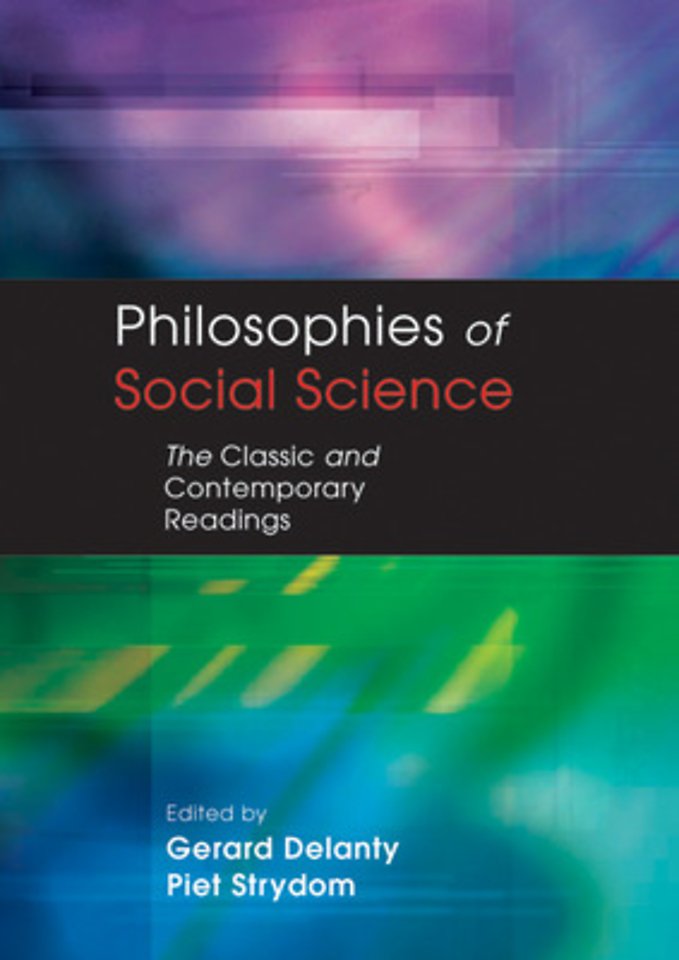
PHILOSOPHIES OF SOCIAL SCIENCE

Specificaties
Paperback, blz. | Engels
McGraw-Hill Education | e druk, 2003
ISBN13: 9780335208845
Rubricering
McGraw-Hill Education e druk, 2003 9780335208845
€ 55,85
Levertijd ongeveer 10 werkdagen

Samenvatting

“This book will certainly prove to be a useful resource and reference point … a good addition to anyone’s bookshelf.” Network

"This is a superb collection, expertly presented. The overall conception seems splendid, giving an excellent sense of the issues... The selection and length of the readings is admirably judged, with both the classic texts and the few unpublished pieces making just the right points." William Outhwaite, Professor of Sociology, University of Sussex

"... an indispensable book for all of us in philosophy and the social sciences who teach and care about the shape of social knowledge in the future." Steven Seidman, Professor of Sociology, State University of New York Albany

"For a comprehensive account of the ways in which world transformations affect claims to social scientific knowledge, one need look no further than Gerard Delanty and Piet Strydom's Philosophies of Social Science. ...this collection captures nicely the increasingly engaged political nature of the philosophy of social science. Debates about pragmatism, feminism and postmodernism are particularly well represented" The AustralianWhat is social science? How does it differ from the other sciences?What is the meaning of method in social science?What is the nature and limits of scientific knowledge?This collection of over sixty extracts from classic works on the philosophy of social science provides an essential textbook and a landmark reference in the field. It highlights the work of some of the most influential authors who have shaped social science.

The texts explore the question of truth, the meaning of scientific knowledge, the nature of methodology and the relation of science to society, including edited extracts from both classic and contemporary works by authors such as Emile Durkheim, Georg Simmel, Max Weber, Alfred Schutz, Max Horkheimer, Jurgen Habermas, Alvin Gouldner, Karl-Otto Apel, Michel Foucault, Pierre Bourdieu, Anthony Giddens, Dorothy Smith, Donna Haraway, Sigmund Freud, Jacques Derrida and Claude Levi-Strauss.

The readings are representative of the major schools of thought, including European and American trends in particular as well as approaches that are often excluded from mainstream traditions. From a teaching and learning perspective the volume is strengthened by extensive introductions to each of the six sections, as well as a general introduction to the reader as a whole. These introductions contextualise the readings and offer succinct summaries of them.

This volume is the definitive companion to the study of the philosophy of social science, taught within undergraduate or postgraduate courses in sociology and the social sciences.

Specificaties

ISBN13:9780335208845
Taal:Engels
Bindwijze:paperback

Inhoudsopgave

Preface and acknowledgements<br>INTRODUCTION<br>What is the philosophy of social science? <p><B>PART 1<br>Positivism, its dissolution and the emergence of post-empiricism</B><br>Introduction: a general outline<br>The selected texts<br>1 EMILE DURKHEIM<br>What is a social fact? (1895) <br>2 OTTO NEURATH<br>The scientific world conception (1929) <br>3 CARL G. HEMPEL<br>Concept and theory in social science (1952) <br>4 ERNST NAGEL<br>Methodological problems of the social sciences (1961) <br>5 KARL POPPER <br>The problem of induction (1934) <br>6 RUDOLF CARNAP<br>Confirmation, testing and meaning (1936) <br>7 TALCOTT PARSONS<br>Theory and empirical fact (1937) <br>8 A.J. AYER<br>The characterization of sense-data (1940) <br>9 W.V.O. QUINE<br>Two dogmas of empiricism (1951) <br>10 LUDWIG WITTGENSTEIN<br>Language games and meaning (1953) <br>11 STEPHEN TOULMIN<br>The evolution of scientific ideas (1961) <br>12 THOMAS KUHN<br>A role for history (1962) <br>13 IMRE LAKATOS<br>Falsification and the methodology of scientific research programmes (1970) <br>14 PAUL FEYERABEND<br>Against method (1975) <p><B>PART 2<br>The interpretative tradition</B><br>Introduction: a general outline<br>The selected texts<br>15 WILHELM DILTHEY<br>The development of hermeneutics (1900) <br>16 GEORG SIMMEL<br>On the nature of historical understanding (1918) <br>How is society possible? (1908) <br>17 MAX WEBER<br>‘Objectivity’ in social science (1904) <br>18 SIGMUND FREUD<br>The dream-work (1900) <br>A philosophy of life (1932) <br>19 ERNST CASSIRER<br>From a critique of abstraction to relationalism (1910) <br>20 KARL MANNHEIM<br>Competition as a cultural phenomenon (1929) <br>21 ALFRED SCHUTZ<br>Concept and theory formation in the social sciences (1954) <br>22 MAURICE MERLEAU-PONTY<br>The philosopher and sociology (1960) <br>23 MARTIN HEIDEGGER<br>The age of the world picture (1938) <br>24 PETER WINCH<br>Philosophy and science (1958) <br>25 HANS-GEORG GADAMER<br>Hermeneutical understanding (1960) <br>26 JÜRGEN HABERMAS<br>The hermeneutic claim to universality (1973) <br>27 PAUL RICOEUR<br>Towards a critical hermeneutic: hermeneutics and the critique of ideology (1973) <br>28 CHARLES TAYLOR<br>Interpretation and the sciences of man (1971) <br>29 CLIFFORD GEERTZ<br>The thick description of culture (1973) <br>30 AARON CICOUREL<br>Method and measurement (1964) <br>31 HAROLD GARFINKEL<br>Rational properties of scientific and common-sense activities (1960) <br>32 ERVING GOFFMAN<br>Primary frameworks (1974) <p><B>PART 3<br>The critical tradition</B><br>Introduction: a general outline<br>The selected texts<br>33 MAX HORKHEIMER<br>Traditional and critical theory (1937) <br>34 HERBERT MARCUSE<br>Philosophy and critical theory (1937) <br>35 THEODOR W. ADORNO<br>Sociology and empirical research (1969) <br>36 JÜRGEN HABERMAS<br>Knowledge and human interests (1965) <br>The tasks of a critical theory (1981) <br>37 KARL-OTTO APEL<br>Types of social science in light of human cognitive interests (1977) <br>38 ALBRECHT WELLMER<br>Critical theory of society (1969) <br>39 ROBERTO MANGABEIRA UNGER<br>The critical argument (1975) <br>40 ALVIN GOULDNER<br>Towards a refiexive sociology (1970) <p><B>PART 4<br>Pragmatism, semiotics and transcendental pragmatics</B><br>Introduction: a general outline<br>The selected texts<br>41 CHARLES S. PEIRCE<br>A definition of pragmatic and pragmatism (1902) <br>42 JOHN DEWEY<br>Social inquiry (1938) <br>43 CHARLES MORRIS<br>Foundations of the theory of signs (1938) <br>Pragmatics and semantics (1946) <br>44 C. WRIGHT MILLS<br>Situated actions and vocabularies of motive (1940) <br>45 KARL-OTTO APEL<br>Transcendental pragmatics (1979) <p><B>PART 5<br>The structuralist controversy: language, discouse and practice</B><br>Introduction: a general outline<br>The selected texts<br>46 CLAUDE LÉVI-STRAUSS<br>Structural analysis in linguistics and in anthropology (1958) <br>Language and the analysis of social laws (1951) <br>47 LUCIEN GOLDMANN<br>The human sciences and philosophy (1966) <br>48 MICHEL FOUCAULT<br>The order of things (1966) <br>Power/knowledge (1976) <br>49 JACQUES DERRIDA<br>Structure, sign and play in the discourses of the human sciences (1966) <br>50 PIERRE BOURDIEU<br>The logic of practice (1980) <p><B>PART 6<br>New directions and challenges</B><br>Introduction: a general outline<br>The selected texts<br>51 RICHARD J. BERNSTEIN<br>‘Anti-foundationalism’ (1991) <br>52 PIERRE BOURDIEU<br>Radical doubt (1992) <br>On science and politics (1999) <br>53 ANTHONY GIDDENS<br>Social science as a double hermeneutic (1984) <br>54 DOROTHY SMITH<br>The standpoint of women in the everyday world (1987) <br>55 DONNA HARAWAY<br>Situated knowledges: the science question in feminism and the privilege of partial perspective (1988) <br>56 PATRICIA HILL COLLINS<br>The sociological significance of black feminist thought (1986) <br>57 KARIN KNORR-CETINA<br>Strong constructivism (1993) <br>58 IAN HACKING<br>What is social construction? The teenage pregnancy example (2002) <br>59 STEVE FULLER<br>The project of social epistemology and the elusive problem of knowledge in contemporary society (2002) <br>60 NIKLAS LUHMANN<br>The cognitive program of constructivism and a reality that remains unknown (1990) <br>61 ROY BHASKAR <br>Transcendental realism and the problem of naturalism (1979) <br>62 JON ELSTER<br>Rational choice and the explanation of social action (2001) <br>63 RANDALL COLLINS<br>Sociological realism (1998) <br>64 JÜRGEN HABERMAS<br>Realism after the linguistic-pragmatic turn (1999) <br>Further reading<br>Index
€ 55,85
Levertijd ongeveer 10 werkdagen

Rubrieken

    Personen

      Trefwoorden

        PHILOSOPHIES OF SOCIAL SCIENCE