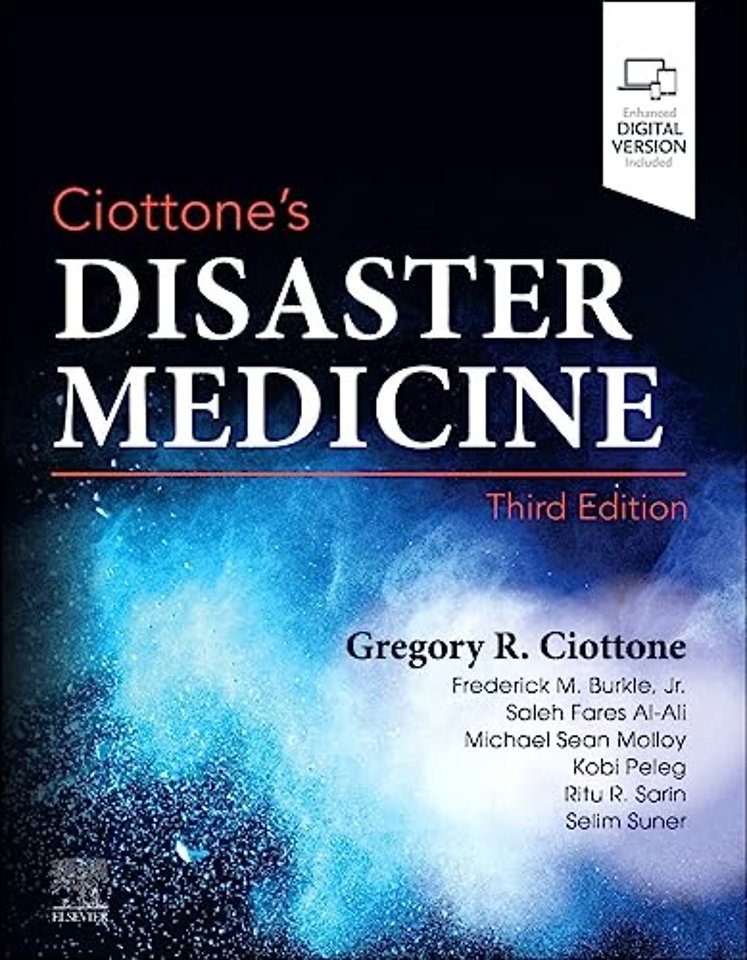
Ciottone's Disaster Medicine

Specificaties
Gebonden, blz. | Engels
Elsevier Health Sciences | e druk, 2023
ISBN13: 9780323809320
Rubricering
Elsevier Health Sciences e druk, 2023 9780323809320
€ 189,74
Levertijd ongeveer 8 werkdagen

Samenvatting

**Selected for Doody’s Core Titles® 2024 in Emergency Medicine**

While medical specialists in disaster mitigation, preparedness, and response are needed worldwide, the initial phase of disaster response is almost entirely dependent upon local resources—making it essential that all healthcare personnel have a working knowledge of the field and stand ready to integrate into the response system. Ciottone's Disaster Medicine, 3rd Edition, is the most comprehensive reference available to help accomplish these goals in every community. It thoroughly covers isolated domestic events as well as global disasters and humanitarian crises. Dr. Gregory Ciottone and more than 200 worldwide authorities share their knowledge and expertise on the preparation, assessment, and management of both natural and man-made disasters, including lessons learned by the responders to contemporary disasters such as the COVID-19 pandemic, Australian and western U.S. wildfires, European heatwaves, the Beirut explosion, recent hurricanes and typhoons, and the global refugee crisis.Part 1 offers an A-to-Z resource for every aspect of disaster medicine and management, while Part 2 features an exhaustive compilation of every conceivable disaster event, organized to facilitate quick reference in a real-time settingCovers basic concepts such as identification of risks, organizational preparedness, equipment planning, disaster education and training, and more advanced concepts such as disaster risk reduction, health in complex emergencies, building local disaster resiliency, psychological impact of disasters on children, and moreContains new decision trees throughout that help guide you through the decision-making process in difficult situationsUses an easy-to-follow, templated approach to historical perspectives, overviews of current practice including pre-incident and post-incident actions, medical treatment of casualties, and potential pitfallsIncludes updated sections on man-made disasters, including mass casualties, active shooter situations, integrated response to terrorist attacks, and chemical/biological/radiological/nuclear/high-yield explosives disastersDiscusses the latest technologies, such as the use of mobile disaster applications, drone response systems, and virtual reality simulation trainingFeatures thoroughly updated information on crisis leadership, practical applications of disaster epidemiology, disaster and climate change, and the integration of non-government agencies (NGOs) in disaster response—a critical topic for those responding to humanitarian needs overseasIncludes new chapters on Pandemic Preparedness and Response, Disaster Medicine in a Changing Climate, Disaster Response in Asia, Building Local Capacity and Disaster Resiliency, Civilian-Military Coordination in Disaster Response, Medical Simulation in Disaster Preparedness, Disaster Nursing, Crisis Meta-Leadership, Palliative Care in Disasters, Counter-Terrorism Medicine, SARS CoV (COVID-19 and SARS), and Disasters in Space TravelAn eBook version is included with purchase. The eBook allows you to access all of the text, figures and references, with the ability to search, customize your content, make notes and highlights, and have content read aloud

Specificaties

ISBN13:9780323809320
Taal:Engels
Bindwijze:Gebonden

Inhoudsopgave

1 Introduction to Disaster Medicine<br>2 Public Health and Disasters<br>3 Role of Emergency Medical Services in Disaster Management and Preparedness<br>4 Role of Emergency Medicine in Disaster Management<br>5 Role of Hospitals in Disaster<br>6 Pandemic Preparedness and Response<br>7 Health In Complex Emergencies<br>8 Disaster Medicine in a Changing Climate<br>9 Children and Disaster<br>10 Psychological Impact of Disaster on Displaced Populations and Refugees of Multiple Traumas<br>11 Ethical Issues in Disaster Medicine<br>12 Issues of Liability in Emergency Response<br>13 Disaster Response in the United States<br>14 Disaster Response in Europe<br>15 Disaster Response in Asia<br>16 Building Local Capacity and Disaster Resiliency<br>17 Local Disaster Response in the United States<br>18 State Disaster Response: Systems and Programs<br>19 Selected U.S. Federal Disaster Response Agencies and Capabilities<br>20 Global Disaster Response and Emergency Medical Teams<br>21 Civil-Military Coordination in Disaster Response<br>22 Evaluation of emerging data to inform disaster response<br>23 Disaster/Emergency Management Programs<br>24 Emergency Department Design<br>25 Hazard Vulnerability Analysis<br>26 Public Information Management<br>27 Informatics and Information Technology in Disaster Medicine<br>28 Medical Simulation in Disaster Preparedness<br>29 Disaster Mitigation<br>30 Disaster Risk Management<br>31 Vaccines<br>32 Occupational and Environmental Medicine: An Asset in Time of Crisis<br>33 Worker Health and Safety in Disaster Response<br>34 Disaster Preparedness<br>35 Policy Issues in Disaster Preparedness and Response<br>36 Mutual Aid<br>37 Disaster Nursing<br>38 Patient Surge<br>39 Accidental Versus Intentional Event<br>40 CRISIS META-LEADERSHIP AND THE PRACTICE OF DISASTER MEDICINE<br>41 The Incident Command System<br>42 Scene Safety and Situational Awareness in Disaster Response<br>43 Pre- and Post-Disaster Needs Assessment<br>44 Operations and Logistics<br>45 Disaster Communications<br>46 Mobile Disaster Applications<br>47 The Role of Social Media in Disasters<br>48 Volunteers and Donations<br>49 Personal Protective Equipment<br>50 Role of Bystanders in Disasters<br>51 Disaster Surveillance Systems<br>52 Use of Geographic Information Systems in Crises<br>53 Management of Mass Fatalities<br>54 Disaster Management of Animals<br>55 Urban Search and Rescue<br>56 Triage<br>57 Patient Tracking Systems in Disasters<br>58 Mass Gatherings<br>59 Infectious Disease in a Disaster Zone<br>60 Pharmaceuticals and Medical Equipment in Disasters<br>61 Displaced Populations<br>62 Palliative Care in Disasters<br>63 Rehabilitation and Reconstruction<br>64 Disaster Education and Research<br>65 Practical Applications of Disaster Epidemiology<br>66 Measures of Effectiveness in Disaster Management<br>67 Counter-Terrorism Medicine<br>68 The Psychology of Terrorism<br>69 Thinking Outside the Box: Health Service Support Considerations in the Era of Asymmetrical Threats<br>70 Integrated Response to Terrorist Attacks<br>71 Coordinated Attack<br>72 Active Shooter Response<br>73 Hostage Taking<br>74 Civil Unrest and Rioting<br>75 Introduction to Explosions and Blasts<br>76 Suicide Bomber<br>77 Improvised Explosive Devices : IED and VBIED<br>78 Conventional Explosions at Mass Gatherings<br>79 Nuclear and Radiation Disaster Management<br>80 Dirty Bomb (Radiological Dispersal Device)<br>81 General Approach to Chemical Attack<br>82 Biological Attack<br>83 Future Biological and Chemical Weapons<br>84 Directed-Energy Weapons<br>85 Chemical, Biological, Radiological, and Nuclear Quarantine<br>86 Decontamination: Chemical and Radiation<br>87 Military Lessons Learned for Disaster Response<br>88 Integration of Law Enforcement and Military Resources with the Emergency Response to a Terrorist Incident<br>89 Tactical Emergency Medical Support<br>90 Operational Rescue<br>91 Operations Security, Site Security, and Incident Response<br>92 Medical Intelligence<br>93 Dignitary Protective Medicine<br>94 Introduction to Natural Disasters<br>95 Hurricanes, Cyclones and Typhoons<br>96 Earthquake<br>97 Tornado<br>98 Flood<br>99 Tsunami<br>100 Heat Wave<br>101 Winter Storm<br>102 Volcanic Eruption<br>103 Famine<br>104 Landslides<br>105 Avalanche<br>106 Introduction to Nuclear and Radiological Disasters<br>107 Nuclear Detonation<br>108 Radiation Accident—Isolated and Dispersed Exposure<br>109 Nuclear Power Plant Meltdown<br>110 Introduction to Chemical Disasters<br>111 Industrial-Chemical Disasters<br>112 Nerve-Agent Mass Casualty Incidents<br>113 Vesicant Agent Attack<br>114 Respiratory-Agent Mass Casualty Incident (Toxic Inhalational Injury)<br>115 Asphyxiant (Cyanide) Attack<br>116 Antimuscarinic Agent Attack<br>117 Mass Casualty Incidents from Hallucinogenic Agents: LSD, Other Indoles, and Phenylethylamine Derivatives<br>118 Opioid Agent Attack<br>119 Caustic Agent Mass Casualty Incident, with Special Emphasis on Hydrogen Fluoride (HF)<br>120 Mass Casualties from Crowd-Control Agents<br>121 Cholinergic Agent Attack (Nicotine, Epibatidine, and Anatoxin-A)<br>122 Anesthetic-Agent Mass Casualty Incident<br>123 Introduction to Biologic Agents<br>124 Bacillus Anthracis (Anthrax) Attack<br>125 Yersinia Pestis (Plague) Bioterrorism Attack<br>126 Francisella Tularensis (Tularemia) Attack<br>127 Brucella Species (Brucellosis) Attack<br>128 Coxiella burnetii (Q Fever) Attack<br>129 Rickettsia prowazekii Attack (Typhus Fever)<br>130 Orientia Tsutsugamushi (Scrub Typhus) Attack<br>131 Rickettsia rickettsii (Rocky Mountain Spotted Fever) Attack<br>132 Vibrio cholerae (Cholera) Attack<br>133 Shigella dysenteriae (Shigellosis) Attack<br>134 Salmonella (Salmonellosis and Typhoid Fever) Attack<br>135 Burkholderia (Glanders and Melioidosis) Attack<br>136 Chlamydophila psittaci (Psittacosis) Attack<br>137 Escherichia coli O157:H7 Attack (Enterohemorrhagic E. Coli )<br>138 Viral Encephalitis caused by Alphaviruses<br>139 Tick-Borne Encephalitis Virus Attack<br>140 Viral Hemorrhagic Fever Attack<br>141 Variola Major Virus (Smallpox) Attack<br>142 Influenza Virus Attack<br>143 Monkeypox Attack<br>144 Hantavirus Pulmonary Syndrome Attack<br>145 Henipavirus Attack: Hendra and Nipah Viruses<br>146 SARS-CoV (COVID-19 and SARS)<br>147 Staphylococcal Enterotoxin B Attack<br>148 Clostridium botulinum Toxin (Botulism) Attack<br>149 Clostridium perfringens Toxin (Epsilon Toxin) Attack<br>150 Marine Toxin Attack<br>151 T-2 Toxin (Trichothecene Mycotoxins) Attack<br>152 Ricin Toxin from Ricinus communis (Castor Bean) Attack<br>153 Aflatoxin (Aspergillus Species) Attack<br>154 Coccidioides immitis (Coccidioidomycosis) Attack<br>155 Histoplasma capsulatum (Histoplasmosis) Attack<br>156 Cryptosporidium parvum (Cryptosporidiosis) Attack<br>157 Explosions: Fireworks<br>158 Rocketpropelled Grenade Attack<br>159 Conventional Explosion at a Hospital<br>160 Conventional Explosion in a High-Rise Building<br>161 Conventional Explosion at a Nuclear Power Plant<br>162 Tunnel Explosion<br>163 Liquified Natural Gas Explosion<br>164 Liquified Natural Gas Tanker Truck Explosion<br>165 Petroleum Distillation and Processing Facility Explosion<br>166 Introduction to Fires and Burns<br>167 Structure Fires<br>168 Wildland Fires and the Wildland Urban Interface<br>169 Tunnel Fire<br>170 Gunshot Attack: Mass Casualties <br>171 Sniper Attack<br>172 Introduction To Structural Collapse (Crush Injury and Crush Syndrome)<br>173 Train Derailment<br>174 Subway Derailment<br>175 Bus Accident<br>176 Aircraft Crash Preparedness and Response<br>177 Air Show Disaster<br>178 Asteroid Impacts, Orbital Debris and Spacecraft Re-entry Disasters<br>179 Building Collapse<br>180 Bridge Collapse<br>181 Human Stampede<br>182 Mining Accident<br>183 Submarine or Surface Vessel Accident<br>184 Aircraft Hijacking<br>185 Aircraft Crash into a High-Rise Building<br>186 Maritime Disasters<br>187 Cruise Ship Infectious Disease Outbreak <br>188 Massive Power System Failures <br>189 Hospital Power Outages<br>190 Intentional Contamination of Water Supplies<br>191 Food-Supply Contamination<br>192 Ecological Terrorism<br>193 Computer and Electronic Terrorism and Emergency Medical Services<br>194 Disasters in Space Travel: From Earth to Orbit, and Beyond
€ 189,74
Levertijd ongeveer 8 werkdagen

Rubrieken

    Personen

      Trefwoorden

        Ciottone's Disaster Medicine