,

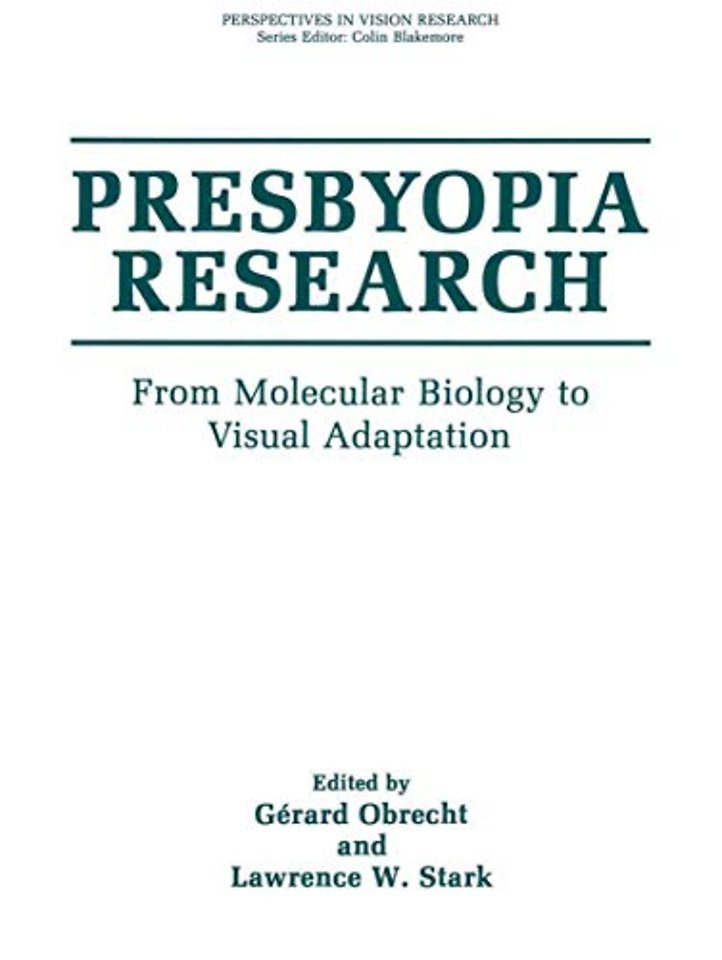
Presbyopia Research

From Molecular Biology to Visual Adaptation

Specificaties
Gebonden, 301 blz. | Engels
Springer US | 1991e druk, 1991
ISBN13: 9780306436598
Rubricering
Springer US 1991e druk, 1991 9780306436598
Onderdeel van serie Perspectives in Vision Research
€ 183,99
Levertijd ongeveer 8 werkdagen

Samenvatting

Seeing is life. Seeing is transfonning luminous col­ We wish to extend our academic and theoretical ored stimulations and shapes into amental represen­ knowledge and also to complete and exchange our tation, structured in space and in time. But seeing is technical and professional experience to prepare also opening onto the world that surrounds us: it is corrective means for the future. thus a means for communicating and learning. Numerous questions have yet to be answered, Jean-Jacques Rousseau, a philosopher worth such as: quoting during the bicentennial of the French Revo­ lution of which he was an instigator, stated, "of all • Will it one day be possible to defer or stop the the senses, vision is that wh ich can be the least aging of the accommodative apparatus? readily separated from judgments of the mind. " • Is further improvement of the current corrective Sight is increasingly called on in our modern means possible, whether spectacles or contact world. Maturity is affected at about 40-45 years by lenses? the on set of presbyopia. Atthat age, which demands • How are behavioral and psychological presbyope all our intellectual and physical means, our sight typologies to be integrated in the course of exam­ should be irreproachable. Our efficiency must not be ination, prescription, and fitting with corrective diminished.

Specificaties

ISBN13:9780306436598
Taal:Engels
Bindwijze:gebonden
Aantal pagina's:301
Uitgever:Springer US
Druk:1991

Inhoudsopgave

I. Molecular Biology of the Lens: New Approaches in Lens Development and Aging.- 1. Transcriptional Control of the ? Crystallin Gene Family.- 2. Molecular and Cellular Mechanisms of Lens Growth Control during Development and Aging.- 3. Differentiation Patterns in Eye Lens Fibers.- 4. Lens Calcium and Cataract.- 5. Molecular Interactions of Crystallins in Relation to Optical Properties.- 6. Biophysical Analysis of Eye Lens Transparency.- 7. Nonenzymic Posttranslational Modification of Lens Proteins in Aging.- 8. Lenticular Senescence and the Retina.- II. Visuomotor Adaptation and Gaze Adaptation.- 9. Adaptations to Transformations of the Optic Array.- 10. Adaptation to Anamorphosing Lenses: Perceptive Responses and Visuomotor Coordination.- 11. Adaptive Control of Saccade Metrics.- 12. Short-Term and Long-Term Adaptative Changes in Eye—Head Movement Coordination Resulting from Reduced Peripheral Vision.- 13. The Disruptive Effects of Optical Aids on Retinal Image Stability during Head Movements.- 14. Neurophysiology of Vergence and Accommodation.- 15. Oculomotor Adaptation to Induced Vergence Demands.- 16. Adaptive Regulation of Accommodative Vergence Interactions.- IIIA. Mechanisms for Separating Superimposed Images.- 17. A Breakdown in Simultaneous Information Processing.- 18. Ambiguous Figures: A Paradigm for Separation of Superimposed Images.- 19. Complementary Cognitive and Motor Image Processing.- 20. The Psychoanatomy of Binocular Single Vision.- 21. The Role of Binocular Disparity Vergence Eye Movements in Disambiguating Superimposed Retinal Images.- 22. Disambiguation of Objects by Stereopsis and Motion Cues.- IIIB. Accommodation and Its Role in Separating Superimposed Images.- 23. Magnetic Resonance Imaging of the Presbyopic Eye.- 24. The Relationshipbetween Ciliary Muscle Contraction and Accommodative Response in the Presbyopic Eye.- 25. Discrimination of Blur in Normal and Amblyopic Eyes.- 26. Preclinical Presbyopic Development.- 27. Ocular Dominance, Accommodation, and the Interocular Suppression of Blur in Monovision.- Conclusions III A and III B.- Closing Address.- ClosingSpeech.
€ 183,99
Levertijd ongeveer 8 werkdagen

Rubrieken

    Personen

      Trefwoorden

        Presbyopia Research