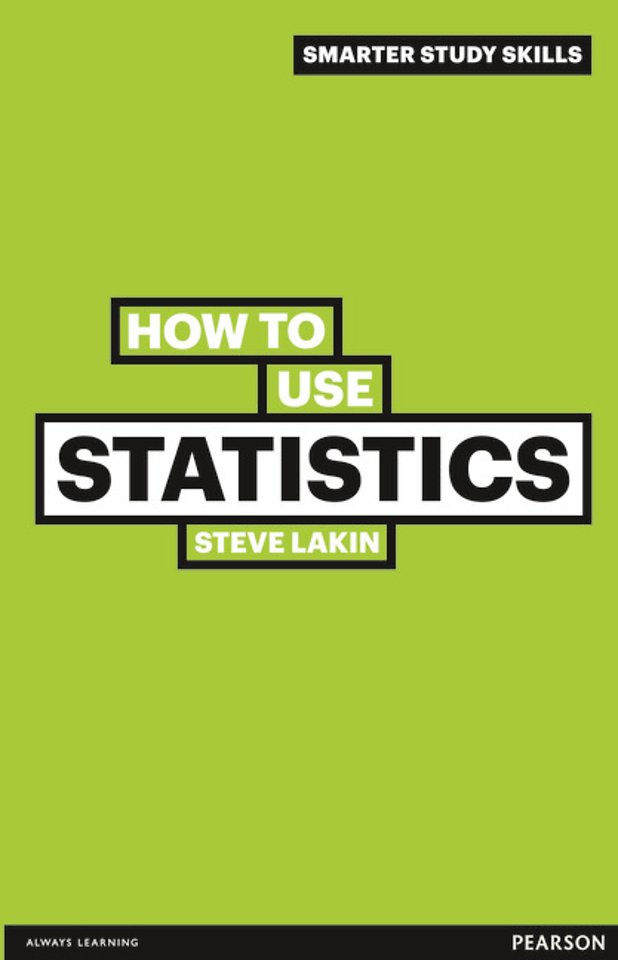
How to Use Statistics

Specificaties
Paperback, blz. | Engels
Pearson Education | e druk, 2011
ISBN13: 9780273743873
Rubricering
Pearson Education e druk, 2011 9780273743873
Onderdeel van serie Smarter Study Skills
€ 18,94
Levertijd ongeveer 8 werkdagen

Samenvatting

How to Use Statistics

Steve Lakin


Is there a secret to successful study? The answer is no! But there are some essential skills and smart strategies that will help you to improve your results at university.


This easy-to-use guide identifies and addresses the areas where most students need help with basic statistics problems that occur in everyday life and academic study and provides straightforward, practical tips and solutions that will enable you to assess and then improve your performance.


How to Use Statistics provides all of the tips, tools and techniques that you will need to build your confidence and improve your results with statistical problems and research, including:


·        How to research, analyse and present your data effectively

·        How to feel more confident understanding and using distributions, confidence limits & probability effectively

·        How to present statistical data clearly in your research, using graphs & charts

·        How to conquer any fears of statistics and understand its importance and relevance to your study and everyday life.


Steve Lakin is an award-winning lecturer in Mathematics at the University of Glamorgan, where he specialises in teaching basic mathematics to a wide range of students across all courses.


Visit www.smartstudyskills.com to access a wealth of useful information, tips, templates and interactive activities that will support your skills development.

Specificaties

ISBN13:9780273743873
Taal:Engels
Bindwijze:Paperback

Inhoudsopgave

<p><strong>Preface and acknowledgements</strong></p> <p><strong>How to use this book</strong></p> <p><strong>A note on mathematics, calculators and computer software</strong></p> <p><strong>Introductory statistics</strong></p> <p>1. Introduction to statistics and data</p> <p>2. Presentation of data</p> <p>3. Averages</p> <p>4.&nbsp;Cumulative frequencies and percentiles</p> <p>5. Measures of dispersion</p> <p>6. Working with frequency distributions</p> <p><strong>Essential mathematics</strong></p> <p>7. Factorials, permutations and combinations</p> <p>8. Sigma notation</p> <p><strong>Correlation and regression</strong></p> <p>9. Correlation</p> <p>10. Linear regression</p> <p><strong>Probability</strong></p> <p>11. An introduction to probability</p> <p>12. Multiple probabilities</p> <p>13. Probability trees</p> <p>14. Expected values and decision criteria</p> <p>15. Conditional probability</p> <p><strong>Probability distributions</strong></p> <p>16. Introduction to probability distributions</p> <p>17. The Poisson distribution</p> <p>18. The normal distribution</p> <p>19. The binormal distribution</p> <p><strong>Hypothesis testing</strong></p> <p>20.&nbsp; Introduction to hypothesis testing.&nbsp;&nbsp;</p> <p>21.&nbsp; z-tests</p> <p>22.&nbsp; t-tests</p> <p>23.&nbsp; ÷2-tests</p> <p>24.&nbsp; F-tests. The use of F-tests for comparison of variances</p> <p><strong>Statistical Tables</strong></p> <p>Table A - The normal distribution N(0, 1)</p> <p>Table B - Confidence limits for the z-test</p> <p>Table C1 - The one-tailed t-test</p> <p>Table C2 - The two-tailed t-test</p> <p>Table D - Critical values for the ÷2 distribution</p> <p>Table E1 - Critical values for the F-test (5%) </p> <p>Table E2 - Critical values for the F-test (1%) </p> <p><strong>Summary, glossary&nbsp;and appendices</strong></p> <p>Summary and further work</p> <p>Glossary</p> <p>Appendix 1 - 'Use of a calculator' test</p> <p>Appendix 2 - The Greek alphabet</p> <p>Appendix 3 - Some useful Excel commands<br><br></p> <p>Solutions to exercises</p> <p><br>&nbsp;</p>
€ 18,94
Levertijd ongeveer 8 werkdagen

Rubrieken

    Personen

      Trefwoorden

        How to Use Statistics