,

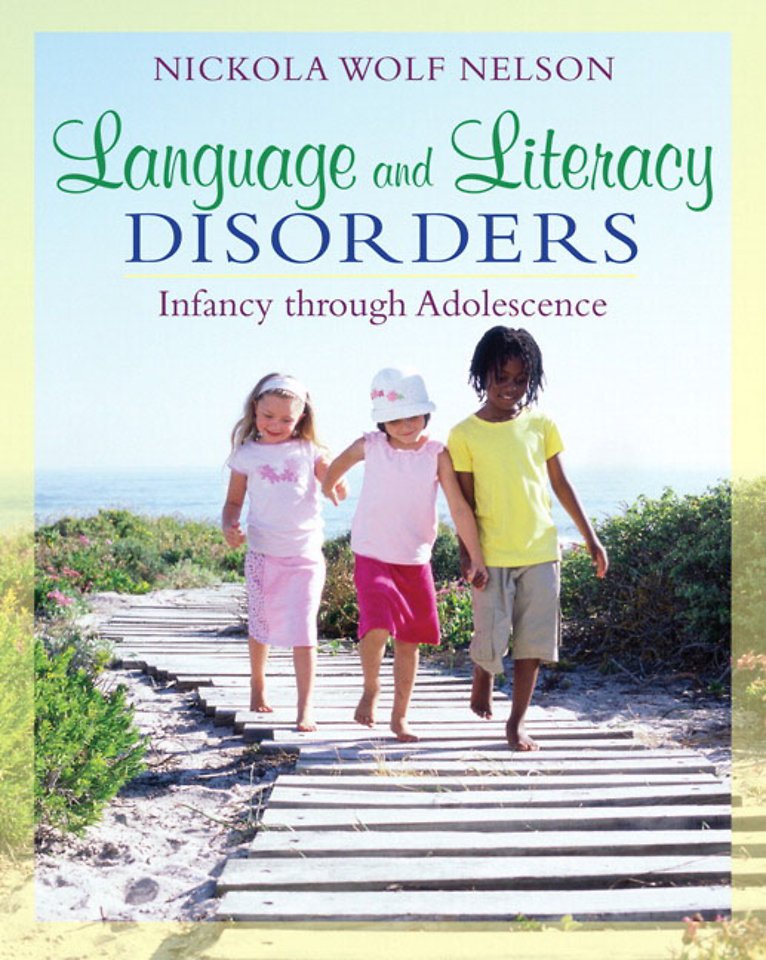
Language and Literacy Disorders

Infancy through Adolescence

Specificaties
Paperback, blz. | Engels
Pearson Education | e druk, 2009
ISBN13: 9780205501786
Rubricering
Pearson Education e druk, 2009 9780205501786
€ 228,94
Levertijd ongeveer 8 werkdagen

Samenvatting

Designed for both undergraduate and graduate students, Childhood Language and Literacy Disorders: Infancy Through Adolescence allows readers to gain essential knowledge that can inform, and transform, their work with children who have special learning needs.

Featuring content and questions that encourage deeper thinking about the nature of disordered and normal development, this text makes assessment and intervention practices relevant to the contexts of home, classroom, and peer interactions. Readers will learn to draw on multiple sources of input to develop an assessment picture for a child at any age and stage of development, plan interventions that target developmentally appropriate outcomes in spoken and written language, and apply techniques that are informed by varied theoretical perspectives and a growing evidence base.

This text is organized into three sections that thoroughly cover basic concepts and policies, appropriate assessment and intervention procedures across developmental ages and stages, and common language and literacy disorders amongst children. Written primarily for students in speech-language pathology, this text applies to practitioners, special education teachers, and interdisciplinary instructors. Extended exercises and review materials ensure that students will be fully prepared to work with diverse groups of children in a variety of real-life settings.

Childhood Language and Literacy Disorders: Infancy Through Adolescence...

· Consistently presents the themes of evidence-based practice, analysis of theoretical perspectives and their biases, and an emphasis on learning about categories and classifications through a framework of multiple physiological systems.

· Concretely shows students how to pull information, practices, and disciplines together in addressing spoken and written language disorders across childhood.

· Uses review materials to encourage students to reach higher levels of thinking regarding difficult and controversial concepts, including the ability to appraise sources critically when conducting evidence-based practice reviews independently. Includes illustrated clinical examples of treatment of language and literacy disorders by professionals in multiple disciplines. Utilizes a developmental systems approach that addresses both IDEA and NCLB legislation by associating concrete assessment and intervention activities with specific goal areas and targets at each age and stage of development. Includes advance organizers, review and practice material, chapter summaries, and suggestions for extended learning opportunities in each chapter.

Specificaties

ISBN13:9780205501786
Taal:Engels
Bindwijze:Paperback

Inhoudsopgave

<p><strong><strong>TABLE OF CONTENTS</strong></strong></p> <p><strong>Frontmatter Dedication page</strong></p> <p><strong> Preface</strong></p> <p><strong> Table of contents </strong></p> <p><strong>PART I. FRAMEWORKS FOR CLINICAL PRACTICE </strong></p> <p><strong>Chapter 1. A Framework for Guiding Evidence Based Practice </strong></p> <p> Importance of asking good questions</p> <p> Contextualized assessment and intervention</p> <p> World Health Organization definitions</p> <p><strong>Chapter 2. Speech, Language/Literacy, and Communication</strong></p> <p> Speech, language (including literacy), and communication</p> <p> Five language parameters</p> <p> Content, form, and use</p> <p> Language levels and modalities</p> <p> Cultural-linguistic variation</p> <p><strong>Chapter 3. Language/Literacy and Related Systems</strong></p> <p> Theoretical accounts</p> <p> System theory</p> <p> Systems supporting language development</p> <p><strong>PART II. POLICIES, PRACTICES, AND POPULATIONS</strong></p> <p><strong>Chapter 4. Policies and Practices</strong></p> <p> Policies</p> <p> Clinical practices</p> <p> Categorization, diagnosis, and causation</p> <p> Testing and exclusionary factors in diagnosis</p> <p> Prevalence, prevention, and prognosis</p> <p><strong>Chapter 5. Primary Disorders of Speech, Language, and Literacy </strong></p> <p> Speech-sound disorders</p> <p> Language impairment</p> <p> Learning disability</p> <p> Spoken and written language associations and dissociations</p> <p><strong>Chapter 6. Special Populations with Motor and Sensory Disorders </strong></p> <p> Motor system impairment</p> <p> Auditory system impairment</p> <p> Visual system impairment</p> <p> Other sensory problems</p> <p><strong>Chapter 7. Special Populations with Cognitive-Communicative Disorders</strong></p> <p> Developmental disability</p> <p> Intellectual disability</p> <p> Autism spectrum disorders</p> <p> Acquired brain injury (including traumatic brain injury)</p> <p> Child abuse and neglect</p> <p> Interactive disorders of attention, emotion, and behavior</p> <p><strong>PART III. ASSESSMENT AND INTERVENTION </strong></p> <p><strong>Chapter 8. Infant/Toddler Policies and Practices </strong></p> <p> Policies and practices for infants and toddlers</p> <p> Comprehensive assessment for infants and toddlers</p> <p><strong>Chapter 9. Infant/Toddler Intervention</strong></p> <p> Prelinguistic organization to intentional communication</p> <p> Joint action routines and early play</p> <p> First words to two-word utterances</p> <p> Emergent narratives and literacy</p> <p><strong>Chapter 10. Preschool Policies and Practices</strong></p> <p> Policies and practices in the preschool years</p> <p> Comprehensive assessment in the preschool years</p> <p><strong>Chapter 11. Preschool Intervention</strong></p> <p> Sounds, words, and vocabulary concepts</p> <p> Sentence- and discourse level development</p> <p> Social interaction and play</p> <p> Emergent and early literacy</p> <p><strong>Chapter 12. School-age Policies and Practices</strong></p> <p> Policies and practices in the school-age years</p> <p> Comprehensive assessment in the school-age years</p> <p><strong>Chapter 13. School-age Intervention</strong></p> <p> Intervention scaffolding in the school-age years</p> <p> Discourse-level knowledge and skills</p> <p> Sentence-level knowledge and skills</p> <p> Word-level knowledge and skills</p> <p><strong>Chapter 14. Interventions for Special Populations</strong></p> <p> Comprehensive planning for comprehensive needs</p> <p> Preverbal to intentional communication</p> <p> Echolalia, challenging behaviors, and non-symbolic communication</p> <p> Intervention for children and adolescents with severe speech-production disorders</p> <p> AAC for children and adolescents with complex communication needs</p> <p> Intervention for sensory loss and central processing disorders</p> <p> Intervention for cognitive-communicative disorders</p> <p> Intervention for autism spectrum disorders</p> <p><strong>Backmatter: </strong>Appendices for Part III.</p> <p>References</p> <p>Author Index (to be completed by Allyn &amp; Bacon)</p> <p>Subject Index (to be completed by Allyn &amp; Bacon)</p> <p><strong>On line supports:</strong> Glossary</p> <p>Review and practice questions and key</p> <p> Observation tables</p>
€ 228,94
Levertijd ongeveer 8 werkdagen

Rubrieken

    Personen

      Trefwoorden

        Language and Literacy Disorders