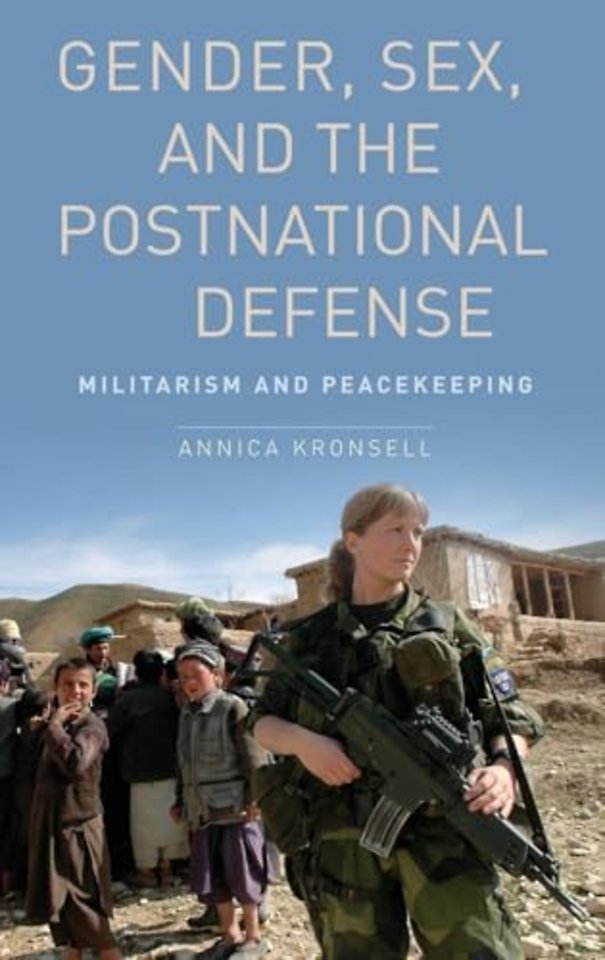
Gender, Sex and the Postnational Defense
Militarism and Peacekeeping
Samenvatting
Scholars have argued that the end of the Cold War and the War on Terror have radically changed the context of war and defense, diminished the role of nation-states in favor of multi-lateral defense activities, and placed a new focus on human security. In addition to the traditional act of war-making, peacekeeping and nation-building have emerged as important defense strategies among wealthy, liberal-democratic nations. Per UN Security Council Resolution 1325, adopted in 2000, all member nations must consider the needs of women and girls during repatriation, resettlement, and post-conflict reconstruction efforts. Kronsell's book looks at the way that a post-national defense influenced by SC 1325 and focused on human security affects gender relations in militaries. Interestingly, despite the successful implementation of gender mainstreaming in training, the number of women involved in military peacekeeping remains low. Contradicting much of the gender mainstreaming literature, Kronsell shows that increasing gender parity in the military is a more achievable task than increasing women's participation.
Employing a feminist constructivist institutional approach, her book questions whether "feminism " must always be equated with peace and anti-militarism, if military violence committed with the purpose of enhancing human security can be performed according to a feminist ethics, and if military institutions can ever be gender neutral. Kronsell builds her theoretical argument on a case study of Sweden and the E.U.