Nivaldo Tro,
Nivaldo J. Tro
Pearson Education
e druk, 2019
9780134989792
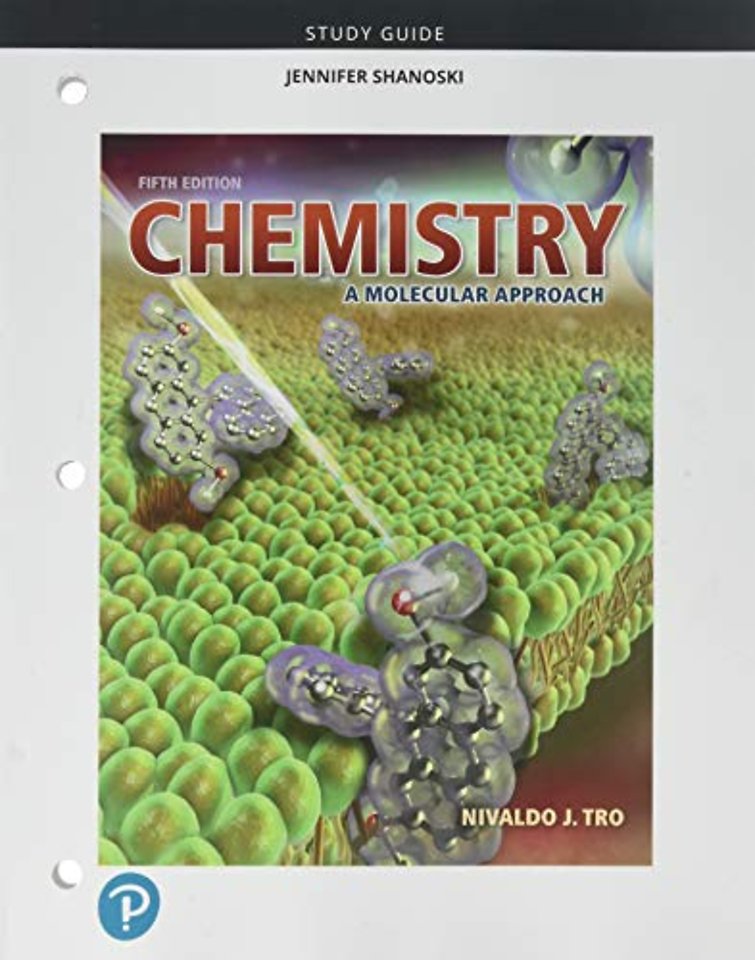
Study Guide for Chemistry
A Molecular Approach
Specificaties
Paperback, blz.
|
Engels
Pearson Education |
e druk, 2019
ISBN13: 9780134989792
Rubricering
Levertijd ongeveer 8 werkdagen
Samenvatting
This Study Guide was written specifically to assist students using the 5th Edition of Chemistry: A Molecular Approach. It presents the major concepts, theories, and applications discussed in the text in a comprehensive and accessible manner for students. It contains learning objectives, chapter summaries and outlines, as well as examples, self tests and concept questions.
Specificaties
Inhoudsopgave
<h2>Brief Contents</h2> <p> </p> <ol> <li>Matter, Measurement, and Problem Solving</li> <li>Atoms and Elements</li> <li>Molecules and Compounds</li> <li>Chemical Reactions and Chemical Quantities</li> <li>Introduction to Solutions and Aqueous Reactions</li> <li>Gases</li> <li>Thermochemistry</li> <li>The Quantum-Mechanical Model of the Atom</li> <li>Periodic Properties of the Elements</li> <li>Chemical Bonding I: The Lewis Model</li> <li>Chemical Bonding II: Molecular Shapes, Valence Bond Theory, and Molecular Orbital Theory</li> <li>Liquids, Solids, and Intermolecular Forces</li> <li>Solids and Modern Materials</li> <li>Solutions</li> <li>Chemical Kinetics</li> <li>Chemical Equilibrium</li> <li>Acids and Bases</li> <li>Aqueous Ionic Equilibrium</li> <li>Free Energy and Thermodynamics</li> <li>Electrochemistry</li> <li>Radioactivity and Nuclear Chemistry</li> <li>Organic Chemistry</li> <li>Biochemistry</li> <li>Chemistry of the Nonmetals</li> <li>Metals and Metallurgy</li> <li>Transition Metals and Coordination Compounds</li> </ol> <h3>Appendix I Common Mathematical Operations in Chemistry</h3> <h3>Appendix II Useful Data</h3> <h3>Appendix III Answers to Selected Exercises</h3> <h3>Appendix IV Answers to In-Chapter Practice Problems</h3> <p></p>