, , , , e.a.

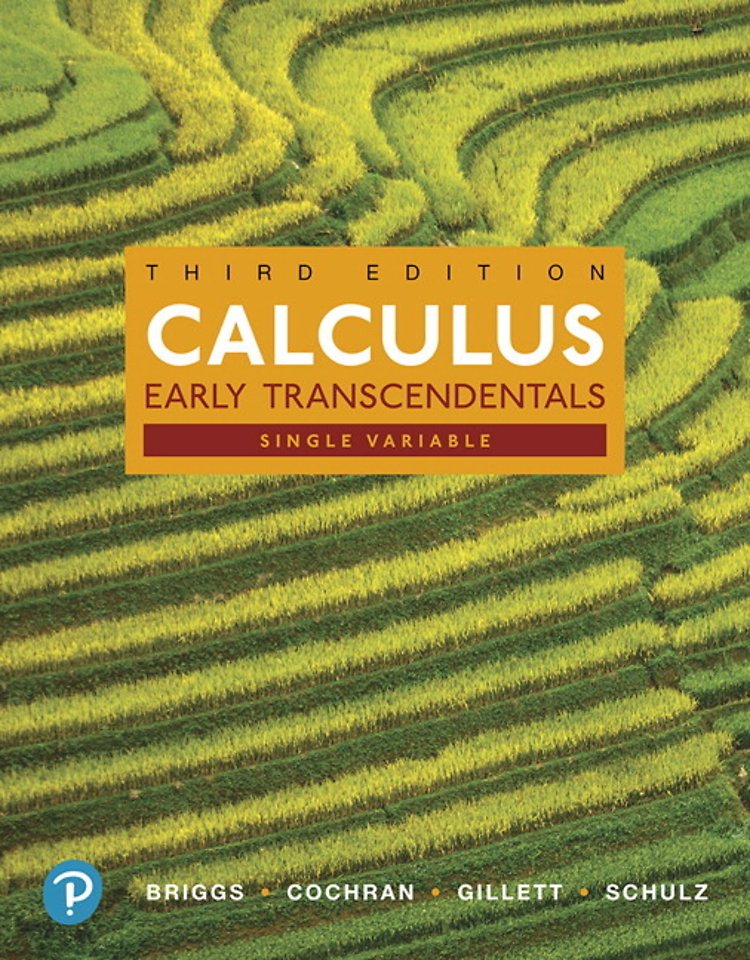
Single Variable Calculus

Early Transcendentals

Specificaties
Paperback, blz. | Engels
Pearson Education | e druk, 2018
ISBN13: 9780134766850
Rubricering
Pearson Education e druk, 2018 9780134766850
€ 165,34
Levertijd ongeveer 8 werkdagen

Samenvatting

For 3- to 4-semester courses covering single-variable and multivariable calculus, taken by students of mathematics, engineering, natural sciences, or economics.

The most successful new calculus text in the last two decades

The much-anticipated 3rd Edition of Briggs’ Calculus Series retains its hallmark features while introducing important advances and refinements. Briggs, Cochran, Gillett, and Schulz build from a foundation of meticulously crafted exercise sets, then draw students into the narrative through writing that reflects the voice of the instructor. Examples are stepped out and thoughtfully annotated, and figures are designed to teach rather than simply supplement the narrative. The groundbreaking eBook contains approximately 700 Interactive Figures that can be manipulated to shed light on key concepts.

For the 3rd Edition, the authors synthesized feedback on the text and MyLab™ Math content from over 140 instructors and an Engineering Review Panel. This thorough and extensive review process, paired with the authors’ own teaching experiences, helped create a text that was designed for today’s calculus instructors and students.

Also available with MyLab Math

MyLab Math is the teaching and learning platform that empowers you to reach every student. By combining trusted author content with digital tools and a flexible platform, MyLab Math personalizes the learning experience and improves results for each student. Learn more about MyLab Math.

Specificaties

ISBN13:9780134766850
Taal:Engels
Bindwijze:Paperback

Inhoudsopgave

<p><strong>1. Functions</strong></p> <p>1.1 Review of Functions</p> <p>1.2 Representing Functions</p> <p>1.3 Inverse, Exponential, and Logarithmic Functions</p> <p>1.4 Trigonometric Functions and Their Inverses</p> <p>Review Exercises</p> <p><strong>2. Limits</strong></p> <p>2.1 The Idea of Limits</p> <p>2.2 Definitions of Limits</p> <p>2.3 Techniques for Computing Limits</p> <p>2.4 Infinite Limits</p> <p>2.5 Limits at Infinity</p> <p>2.6 Continuity</p> <p>2.7 Precise Definitions of Limits</p> <p>Review Exercises</p> <p><strong>3. Derivatives</strong></p> <p>3.1 Introducing the Derivative</p> <p>3.2 The Derivative as a Function</p> <p>3.3 Rules of Differentiation</p> <p>3.4 The Product and Quotient Rules</p> <p>3.5 Derivatives of Trigonometric Functions</p> <p>3.6 Derivatives as Rates of Change</p> <p>3.7 The Chain Rule</p> <p>3.8 Implicit Differentiation</p> <p>3.9 Derivatives of Logarithmic and Exponential Functions</p> <p>3.10 Derivatives of Inverse Trigonometric Functions</p> <p>3.11 Related Rates</p> <p>Review Exercises</p> <p><strong>4. Applications of the Derivative</strong></p> <p>4.1 Maxima and Minima</p> <p>4.2 Mean Value Theorem</p> <p>4.3 What Derivatives Tell Us</p> <p>4.4 Graphing Functions</p> <p>4.5 Optimization Problems</p> <p>4.6 Linear Approximation and Differentials</p> <p>4.7 L'Hôpital's Rule</p> <p>4.8 Newton's Method</p> <p>4.9 Antiderivatives</p> <p>Review Exercises</p> <p><strong>5. Integration</strong></p> <p>5.1 Approximating Areas under Curves</p> <p>5.2 Definite Integrals</p> <p>5.3 Fundamental Theorem of Calculus</p> <p>5.4 Working with Integrals</p> <p>5.5 Substitution Rule</p> <p>Review Exercises</p> <p><strong>6. Applications of Integration</strong></p> <p>6.1 Velocity and Net Change</p> <p>6.2 Regions Between Curves</p> <p>6.3 Volume by Slicing</p> <p>6.4 Volume by Shells</p> <p>6.5 Length of Curves</p> <p>6.6 Surface Area</p> <p>6.7 Physical Applications</p> <p>Review Exercises</p> <p><strong>7. Logarithmic, Exponential, and Hyperbolic Functions</strong></p> <p>7.1 Logarithmic and Exponential Functions Revisited</p> <p>7.2 Exponential Models</p> <p>7.3 Hyperbolic Functions</p> <p>Review Exercises</p> <p><strong>8. Integration Techniques</strong></p> <p>8.1 Basic Approaches</p> <p>8.2 Integration by Parts</p> <p>8.3 Trigonometric Integrals</p> <p>8.4 Trigonometric Substitutions</p> <p>8.5 Partial Fractions</p> <p>8.6 Integration Strategies</p> <p>8.7 Other Methods of Integration</p> <p>8.8 Numerical Integration</p> <p>8.9 Improper Integrals</p> <p>Review Exercises</p> <p><strong>9. Differential Equations</strong></p> <p>9.1 Basic Ideas</p> <p>9.2 Direction Fields and Euler's Method</p> <p>9.3 Separable Differential Equations</p> <p>9.4 Special First-Order Linear Differential Equations</p> <p>9.5 Modeling with Differential Equations</p> <p>Review Exercises</p> <p><strong>10. Sequences and Infinite Series</strong></p> <p>10.1 An Overview</p> <p>10.2 Sequences</p> <p>10.3 Infinite Series</p> <p>10.4 The Divergence and Integral Tests</p> <p>10.5 Comparison Tests</p> <p>10.6 Alternating Series</p> <p>10.7 The Ratio and Root Tests</p> <p>10.8 Choosing a Convergence Test</p> <p>Review Exercises</p> <p><strong>11. Power Series</strong></p> <p>11.1 Approximating Functions with Polynomials</p> <p>11.2 Properties of Power Series</p> <p>11.3 Taylor Series</p> <p>11.4 Working with Taylor Series</p> <p>Review Exercises</p> <p><strong>12. Parametric and Polar Curves</strong></p> <p>12.1 Parametric Equations</p> <p>12.2 Polar Coordinates</p> <p>12.3 Calculus in Polar Coordinates</p> <p>12.4 Conic Sections</p> <p>Review Exercises</p> <p>Appendix A. Proofs of Selected Theorems</p> <p>Appendix B. Algebra Review ONLINE</p> <p>Appendix C. Complex Numbers ONLINE</p> <p>Answers</p> <p>Index</p> <p>Table of Integrals</p>
€ 165,34
Levertijd ongeveer 8 werkdagen

Rubrieken

    Personen

      Trefwoorden

        Single Variable Calculus