Paul Hewitt,
Paul G. Hewitt,
John Suchocki,
John A. Suchocki,
Leslie Hewitt,
Leslie A. Hewitt
e.a.
Pearson Education
e druk, 2016
9780134091396
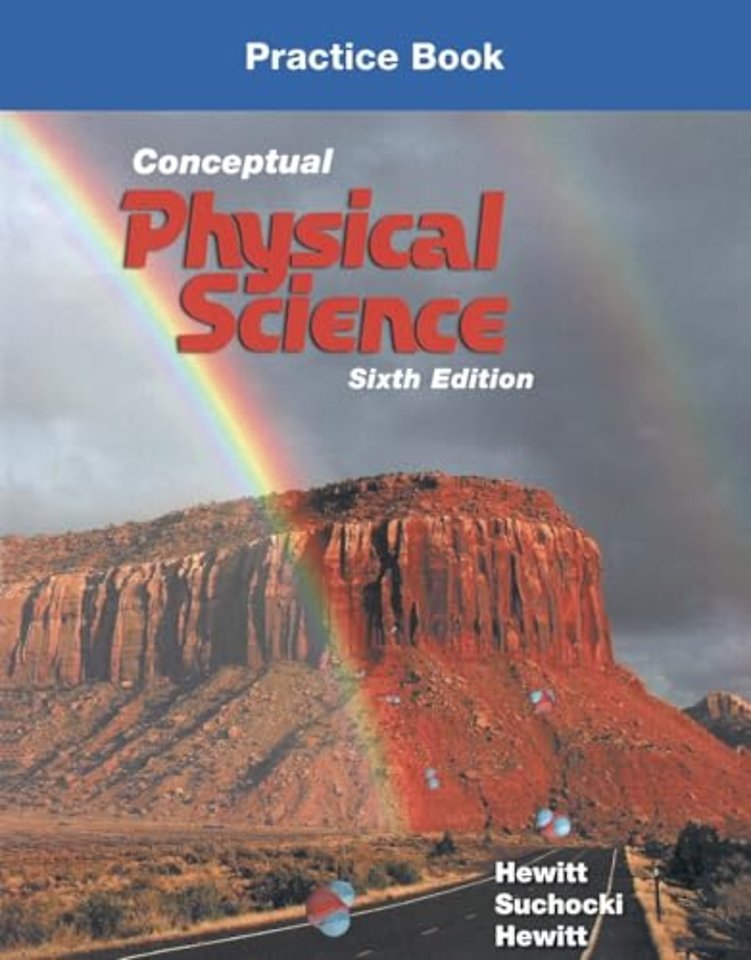
Practice Book for Conceptual Physical Science
Specificaties
Paperback, blz.
|
Engels
Pearson Education |
e druk, 2016
ISBN13: 9780134091396
Rubricering
Levertijd ongeveer 8 werkdagen
Samenvatting
This skill-building workbook helps students build their confidence and understanding of concepts in the textbook by providing additional questions and activities. Answers to all questions are provided at the back of the workbook.
Specificaties
Inhoudsopgave
<p>Prologue: The Nature of Science</p> <p><strong>PART 1: PHYSICS</strong></p> <p>1. Patterns of Motion and Equilibrium</p> <p>2. Newton's Laws of Motion</p> <p>3. Momentum and Energy</p> <p>4. Gravity, Projectiles, and Satellites</p> <p>5. Fluid Mechanics</p> <p>6. Temperature, Heat, and Thermodynamics</p> <p>7. Heat Transfer and Change of Phase</p> <p>8. Static and Current Electricity</p> <p>9. Magnetism and Electromagnetic Induction</p> <p>10. Waves and Sound</p> <p>11. Light</p> <p><strong>PART 2: CHEMISTRY</strong></p> <p>12. Atoms and the Periodic Table</p> <p>13. The Atomic Nucleus and Radioactivity</p> <p>14. Elements of Chemistry</p> <p>15. How Atoms Bond and Molecules Attract</p> <p>16. Mixtures</p> <p>17. How Chemicals React</p> <p>18. Two Classes of Chemical Reactions</p> <p>19. Organic Compounds</p> <p><strong>PART 3: EARTH SCIENCE</strong></p> <p>20. Rocks and Minerals</p> <p>21. Plate Tectonics and Earth’s Interior</p> <p>22. Shaping Earth’s Surface</p> <p>23. Geologic Time—Reading the Rock Record</p> <p>24. The Oceans, Atmosphere, and Climatic Effects</p> <p>25. Driving Forces of Weather</p> <p><strong>PART 4: ASTRONOMY</strong></p> <p>26. The Solar System</p> <p>27. Stars and Galaxies</p> <p>28. The Structure of Space and Time</p>