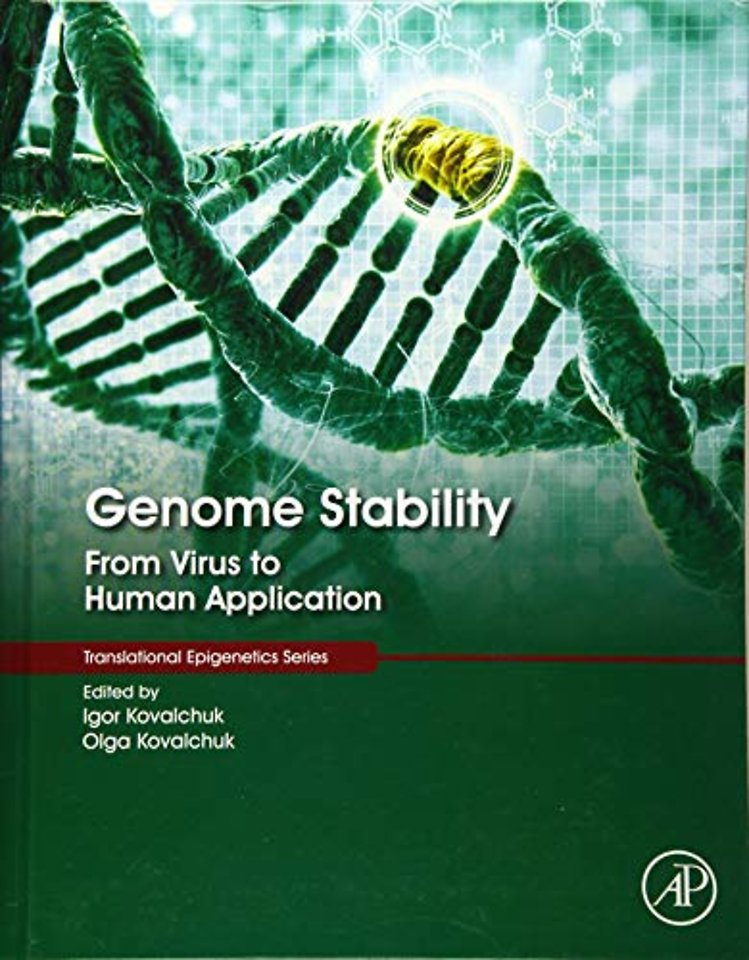
<p>1. Genome stability – an evolutionary perspective<br>Igor Kovalchuk</p> <p>I. Genome Instability of Viruses</p> <p>2. Genetic Instability of RNA Viruses<br>John N. Barr and Rachel Fearns<br>3. Genome instability in DNA viruses<br>Rafael Sanjuán, Marianoel Pereira-Gómez, Jennifer Risso</p> <p>II. Genome instability in Bacteria and Archaea</p> <p>4. Genome instability in bacteria and archaea: Strategies for maintaining genome stability<br>Jan-Erik Messling and Ashley B. Williams</p> <p>5. Genome instability in bacteria: causes and consequences<br>Ashley B. Williams</p> <p>6. CRISPR - bacteria immune system<br>Andrey Golubov</p> <p>III. Genome Stability of Unicellular Eukaryotes</p> <p>7. Programmed DNA rearrangement in ciliates <br>Franziska Jönsson</p> <p>8. Homologous Recombination and Non-homologous End-joining repair in yeast<br>Rebecca E. Jones and Timothy C. Humphrey</p> <p>IV. Genome stability in multicellular eukaryotes</p> <p>9. Meiotic and Mitotic Recombination: First in Flies<br>Julie Korda Holsclaw, Talia Hatkevich and Jeff Sekelsky</p> <p>10. Genome stability in Drosophila – mismatch repair and genome stability<br>Tomoe Negishi</p> <p>11. Genome stability in Caenorhabditis elegans<br>Matthias Rieckher, Amanda Franqueira C. Lopes and Björn Schumacher</p> <p>12. Genetic Engineering of Plants using Zn-fingers, TALENs and CRISPRs<br>Andriy Bilichak and Francois Eudes</p> <p>13. Plant Genome Stability – General Mechanisms<br>Andriy Bilichak</p> <p>V. Genome stability in mammals</p> <p>14. Cell cycle control and DNA damage signalling in mammals<br>Valenti Gomez and Alexander Hergovich</p> <p>15. The role of p53/p21/p16 in DNA damage signalling and DNA repair<br>Yavuz Kulaberoglu, Ramazan Gundogdu, and Alexander Hergovich</p> <p>16. Roles of RAD18 in DNA Replication and Post-Replication Repair (PRR)<br>Cyrus Vaziri, Satoshi Tateishi, Liz Mutter-Rottmayer and Yanzhe Gao</p> <p>17. Base Excision Repair and Nucleotide Excision Repair<br>Tadahide Izumi and Isabel Mellon</p> <p>18. DNA Mismatch Repair in Mammals<br>Mingzhang Yang and Peggy Hsieh</p> <p>19. Repair of double strand breaks by non-homologous end joining; its components and their function<br>Patryk Moskwa</p> <p>20. Double-Strand Break Repair: Homologous Recombination in Mammalian Cells<br>Camille Gelot, Tangui Le-Guen, Sandrine Ragu and Bernard S. Lopez</p> <p>21. Telomere maintenance and genome stability<br>Wilnelly Hernandez-Sanchez, Mengyuan Xu and Derek J. Taylor</p> <p>22. The relationship between checkpoint adaptation and mitotic catastrophe in genomic changes in cancer cells<br>Lucy H. Swift and Roy M. Golsteyn</p> <p>23. Chromatin, nuclear organization and genome stability in mammals <br>Lora Boteva, Nick Gilbert</p> <p>24. Role of DNA methylation in genome stability<br>Dan Zhou and Keith D. Robertson</p> <p>25. Non-coding RNAs in genome integrity<br>Igor Kovalchuk</p> <p><br>VI. Human diseases associated with genome instability<br>26. Human diseases associated with genome instability<br>Bruno César Feltes, Joice de Faria Poloni, Kendi Nishino Miyamoto and Diego Bonatto</p> <p>27. Cancer and genomic instability<br>Wei Wei, Yabin Cheng and Bo Wang</p> <p>28. Chromatin Modifications in DNA Repair and Cancer<br>Margaret Renaud-Young, Karl Riabowol and Jennifer Cobb</p> <p>29. Genomic Instability and Aging – Causes and Consequences<br>Corinne Sidler</p> <p>30. Nucleolar contributions to DNA damage response and genomic (in)stability in the nervous system<br>Michal Hetman</p> <p>VII. Effect of environment on genome stability</p> <p>31. Diet and nutrition<br>Lynnette R. Ferguson</p> <p>32. Chemical mutagenesis</p> <p>33. Environmental sources of ionizing radiation and their health consequences<br>Aaron A. Goodarzi, Alexander Anikin, Dustin D. Pearson</p> <p>Section VIII. Bystander and transgenerational effects – epigenetic perspective</p> <p>34. Epigenetics of transgenerational genome instability in mammals</p> <p>35. Genomic Instability and the Spectrum of Response to Low Radiation Doses<br>Carmel Mothersill and Colin Seymour</p> <p>36. Transgenerational genome instability in plants<br>Igor Kovalchuk</p> <p>37. Methods for the detection of DNA damage<br>Denis V. Firsanov, Ljudmila V. Solovjeva, Vyacheslav M. Mikhailov, Maria P. Svetlova</p> <p>38. Conserved and divergent features of DNA repair. Future perspectives in genome instability research<br>Igor Kovalchuk<br></p>