Gratis boekenweekgeschenk bij een bestelling boven de €17,50 (geldt alleen voor Nederlandstalige boeken)

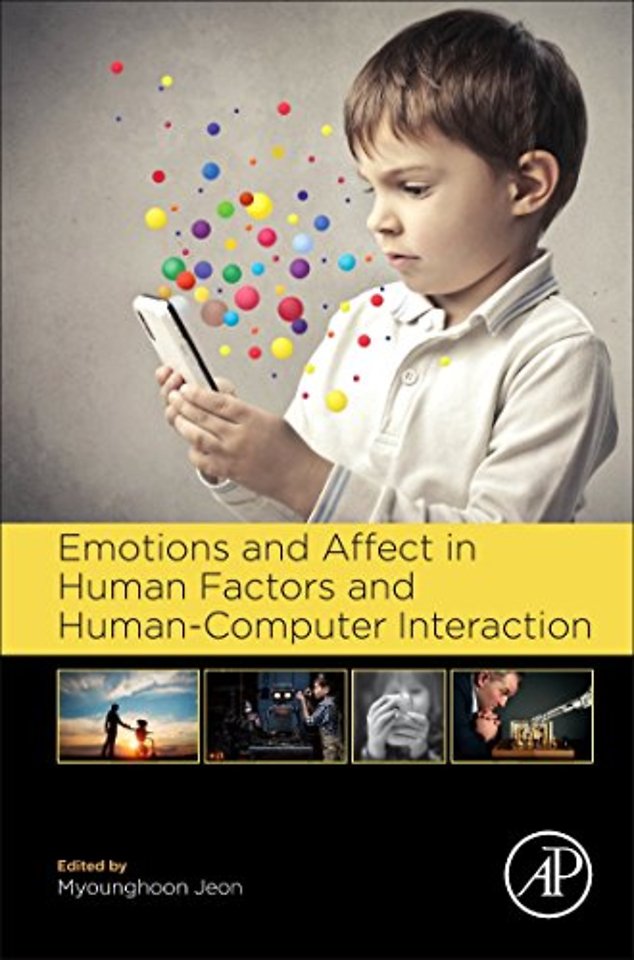
Emotions and Affect in Human Factors and Human-Computer Interaction

Specificaties
Gebonden, blz. | Engels
Elsevier Science | e druk, 2017
ISBN13: 9780128018514
Rubricering
Elsevier Science e druk, 2017 9780128018514
€ 106,54
Levertijd ongeveer 8 werkdagen

Samenvatting

Emotions and Affect in Human Factors and Human–Computer Interaction is a complete guide for conducting affect-related research and design projects in H/F and HCI domains. Introducing necessary concepts, methods, approaches, and applications, the book highlights how critical emotions and affect are to everyday life and interaction with cognitive artifacts.

The text covers the basis of neural mechanisms of affective phenomena, as well as representative approaches to Affective Computing, Kansei Engineering, Hedonomics, and Emotional Design. The methodologies section includes affect induction techniques, measurement techniques, detection and recognition techniques, and regulation models and strategies. The application chapters discuss various H/F and HCI domains: product design, human–robot interaction, behavioral health and game design, and transportation. Engineers and designers can learn and apply psychological theories and mechanisms to account for their affect-related research and can develop their own domain-specific theory. The approach outlined in this handbook works to close the existing gap between the traditional affect research and the emerging field of affective design and affective computing.

Specificaties

ISBN13:9780128018514
Taal:Engels
Bindwijze:Gebonden

Inhoudsopgave

<p>Part I: Foundations of affective sciences<br>1. Emotions and Affect in Human Factors and Human–Computer Interaction: Taxonomy, Theories, Approaches, and Methods<br>2. Neural Mechanisms of Emotions and Affect<br>3. Mood Effects on Cognition: Affective Influences on the Content and Process of Information Processing and Behavior<br>4. Cross-Cultural Similarities and Differences in Affective Processing and Expression<br>5. On the Moral Implications and Restrictions Surrounding Affective Computing </p> <p>Part II: Frameworks of affective sciences in human factors and human-computer interaction<br>6. Design and Emotional Experience<br>7. From Ergonomics to Hedonomics: Trends in Human Factors and Technology—The Role of Hedonomics Revisited<br>8. An Approach Through Kansei Science<br>9. Affective Computing: Historical Foundations, Current Applications, and Future Trends </p> <p>Part III: Methodologies: introduction and evaluation of techniques<br>10. Affect/Emotion Induction Methods<br>11. Affect Measurement: A Roadmap Through Approaches, Technologies, and Data Analysis<br>12. The Role of Registration and Representation in Facial Affect Analysis<br>13. On Computational Models of Emotion Regulation and Their Applications Within HCI</p> <p>Part IV: Applications: case studies and applied examples<br>14. Evolution of Emotion Driven Design<br>15. Affective Human–Robot Interaction<br>16. Computational Modeling of Cognition–Emotion Interactions: Theoretical and Practical Relevance for Behavioral Healthcare<br>17. Emotions in Driving</p> <p>Part V: Emerging areas<br>18. Positive Technology, Computing, and Design: Shaping a Future in Which Technology Promotes Psychological Well-Being<br>19. Subliminal Perception or "Can We Perceive and Be Influenced by Stimuli That Do Not Reach Us on a Conscious Level?"<br>20. Physiological Computing and Intelligent Adaptation<br>21. Aesthetic Computing </p>
€ 106,54
Levertijd ongeveer 8 werkdagen

Rubrieken

    Personen

      Trefwoorden

        Emotions and Affect in Human Factors and Human-Computer Interaction