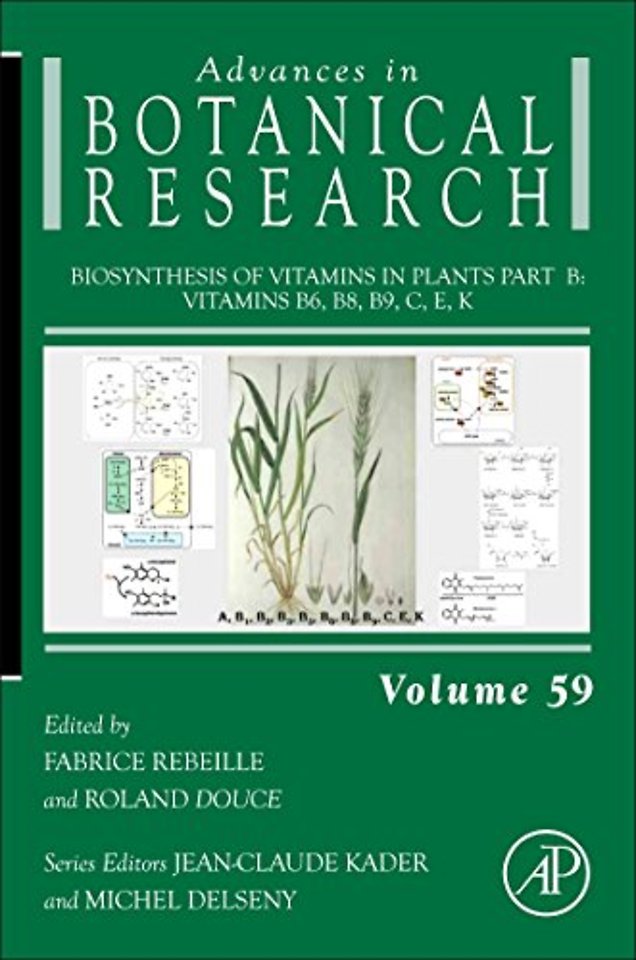
Fabrice Rebeille,
Roland Douce
Elsevier Science
e druk, 2011
9780123858535
Biosynthesis of Vitamins in Plants Part B
Vitamins B6, B8, B9, C, E, K
Specificaties
Gebonden, blz.
|
Engels
Elsevier Science |
e druk, 2011
ISBN13: 9780123858535
Rubricering
Onderdeel van serie
Advances in Botanical Research
Levertijd ongeveer 8 werkdagen
Samenvatting
Edited by Jean-Claude Kader and Michel Delseny and supported by an international Editorial Board, Advances in Botanical Research publishes in-depth and up-to-date reviews on a wide range of topics in plant sciences. The series features a wide range of reviews by recognized experts on all aspects of plant genetics, biochemistry, cell biology, molecular biology, physiology and ecology. This eclectic volume features reviews on cutting-edge topics of interest to postgraduates and researchers alike.
Specificaties
Inhoudsopgave
<p>Series Page</p> <p>Contributors to Volume 59</p> <p>Preface</p> <p>Vitamins: a plant affair</p> <p>Contents of volumes 35-58</p> <p>Vitamin B6 in Plants: More Than Meets the Eye</p> <p>I. Introduction</p> <p>II. Biological Functions and Requirements</p> <p>III. Distribution</p> <p>IV. Biosynthesis and Cellular Location of the Pathways</p> <p>V. Regulation, Turnover and Catabolism</p> <p>VI. Impact of the Vitamin on Plant Physiology and Development</p> <p>VII. Comparison with Other Autotrophic Non-Plant Organisms</p> <p>VIII. Engineering the Pathway for Nutritional Enhancement</p> <p>IX. Conclusions</p> <p>Biotin (Vitamin B8) Synthesis in Plants</p> <p>I. Introduction</p> <p>II. The Biosynthetic Pathway</p> <p>III. Protein Biotinylation</p> <p>IV. Concluding Remarks</p> <p>Metabolism of Folates in Plants</p> <p>I. Folates Structure</p> <p>II. Biological Functions of Folates: C1-Metabolism and Beyond</p> <p>III. Folate Synthesis, Turnover and Homeostasis in Plants</p> <p>IV. Folate Synthesis in Other Autotrophs</p> <p>V. Physiology of Folate in Human Health and Disease</p> <p>VI. Folate Biofortification in Plants</p> <p>Vitamin C: The Metabolism and Functions of Ascorbic Acid in Plants</p> <p>I. Introduction</p> <p>II. Ascorbate Biosynthesis: The D-Mannose/L-Galactose (Man/L-Gal) Pathway</p> <p>III. Are There Multiple Pathways for Ascorbate Biosynthesis?</p> <p>IV. The Control of Ascorbate Biosynthesis and Pathway Engineering</p> <p>V. Ascorbate Catabolism</p> <p>VI. Ascorbate Transport and Subcellular Compartmentation</p> <p>VII. Ascorbate Conjugates</p> <p>VIII. The Redox Reactions of Ascorbate</p> <p>IX. The Functions of Ascorbate</p> <p>X. Conclusions</p> <p>Vitamin E</p> <p>I. A Brief History of Vitamin E Research</p> <p>II. Structure and Chemistry of Tocochromanols and Vitamin E</p> <p>III. Tocochromanol Distribution in Plant Tissues and Foods</p> <p>IV. Vitamin E Requirement in Humans and Biological Functions</p> <p>V. The Tocochromanol Pathway in Photosynthetic Organisms</p> <p>VI. Biochemical Genomics Enabled the Cloning of Tocochromanol Pathway Enzymes</p> <p>VII. Engineering Multiple Steps of the Pathway and Application to Agricultural Crops</p> <p>VIII. Potential for Breeding Plants with Improved Vitamin E Content</p> <p>IX. Progress in Elucidating Tocochromanol Functions in Photosynthetic Organisms</p> <p>Vitamin K<sub>1</sub> (Phylloquinone): Function, Enzymes and Genes</p> <p>I. Introduction</p> <p>II. Structure and Chemistry of Vitamin K</p> <p>III. Biochemical Roles of Vitamin K</p> <p>IV. Detection and Distribution of Phylloquinone in Plants</p> <p>V. Phylloquinone Biosynthesis in Plants</p> <p>VI. Evolution of Naphthoquinone Biosynthesis in Photosynthetic Eukaryotes</p> <p>VII. Phylloquinone Turnover</p> <p>VIII. Engineering of Phylloquinone in Plants</p> <p>IX. Concluding Remarks</p> <p>Author Index</p> <p>Subject Index</p> <p>Biosynthesis of Vitamins in Plants Part B</p> <p>Biosynthesis of Vitamins in Plants Part B</p> <p>Fabrice Rébeillé</p> <p>Roland Douce</p> <p>ISSN 0065-2296</p> <p>Volume 59 • Number Suppl C • 2011</p>