Prem Chandra Pandey,
Prashant K Srivastava,
Prashant K. Srivastava,
Heiko Balzter,
Bimal Bhattacharya,
George P. Petropoulos
e.a.
Elsevier Science
e druk, 2020
9780081028940
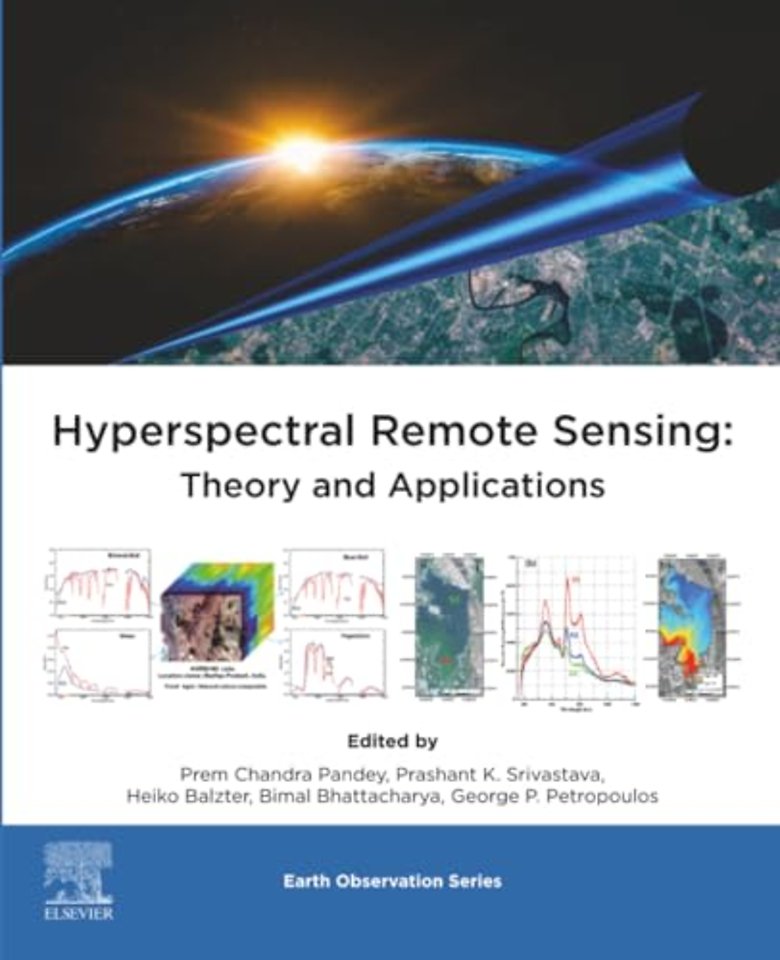
Hyperspectral Remote Sensing
Theory and Applications
Specificaties
Paperback, blz.
|
Engels
Elsevier Science |
e druk, 2020
ISBN13: 9780081028940
Rubricering
Onderdeel van serie
Earth Observation
Levertijd ongeveer 8 werkdagen
Samenvatting
Hyperspectral Remote Sensing: Theory and Applications offers the latest information on the techniques, advances and wide-ranging applications of hyperspectral remote sensing, such as forestry, agriculture, water resources, soil and geology, among others. The book also presents hyperspectral data integration with other sources, such as LiDAR, Multi-spectral data, and other remote sensing techniques. Researchers who use this resource will be able to understand and implement the technology and data in their respective fields. As such, it is a valuable reference for researchers and data analysts in remote sensing and Earth Observation fields and those in ecology, agriculture, hydrology and geology.
Specificaties
ISBN13:9780081028940
Taal:Engels
Bindwijze:Paperback
Uitgever:Elsevier Science
Serie:Earth Observation
Inhoudsopgave
Section 1 Introduction to Hyperspectral Remote Sensing and Principles of Theory and Data Processing<br>1. Revisiting hyperspectral remote sensing: origin, processing, applications and way forward<br>2. Spectral smile correction for airborne imaging spectrometers<br>3. Anomaly detection in hyperspectral remote sensing images<br>4. Atmospheric parameter retrieval and correction using hyperspectral data<br>5. Hyperspectral image classifications and feature selection<br>Section 2 Hyperspectral Remote Sensing Application in Vegetation<br>6. Identification of functionally distinct plants using linear spectral mixture analysis<br>7. Estimation of chengal trees relative abundance using coarse spatial resolution hyperspectral systems<br>8. Hyperspectral remote sensing in precision agriculture: present status, challenges, and future trends<br>9. Discriminating tropical grasses grown under different nitrogen fertilizer regimes in KwaZulu-Natal, South Africa<br>Section 3 Hyperspectral Remote Sensing Application in Water, Snow, Urban Research<br>10. Effect of contamination and adjacency factors on snow using spectroradiometer and hyperspectral images<br>11. Remote sensing of inland water quality: a hyperspectral perspective<br>12. Efficacy of hyperspectral data for monitoring and assessment of wetland ecosystem<br>Section 4 Hyperspectral Remote Sensing Application in Soil and Mineral Exploration<br>13. Spectroradiometry as a tool for monitoring soil contamination by heavy metals in a floodplain site<br>14. Hyperspectral remote sensing applications in soil: a review<br>15. Mineral exploration using hyperspectral data<br>16. Metrological hyperspectral image analysis through spectral differences<br>Section 5 Hyperspectral Remote Sensing: Multi-sensor, Fusion and Indices applications for Pollution<br>Detection and Other Applications<br>17. Improving the detection of cocoa bean fermentation-related changes using image fusion<br>18. Noninvasive detection of plant parasitic nematodes using hyperspectral and other remote sensing systems<br>19. Evaluating the performance of vegetation indices for detecting oil pollution effects on vegetation using hyperspectral (Hyperion EO-1) and multispectral (Sentinel-2A) data in the Niger Delta<br>20. Hyperspectral vegetation indices to detect hydrocarbon pollution<br>Section 6 Hyperspectral Remote Sensing: Challenges, Future Pathway for Research & Emerging Applications<br>21. Future perspectives and challenges in hyperspectral remote sensing