Robert Cahn
Elsevier Science
e druk, 2004
9780080445472
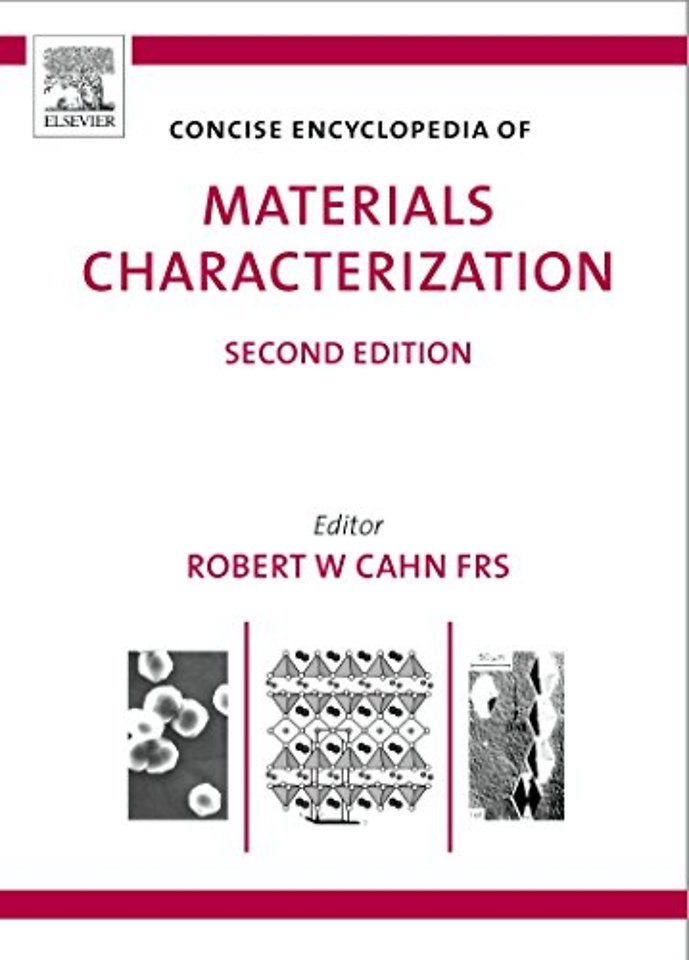
Concise Encyclopedia of Materials Characterization
Specificaties
Gebonden, blz.
|
Engels
Elsevier Science |
e druk, 2004
ISBN13: 9780080445472
Rubricering
Levertijd ongeveer 8 werkdagen
Samenvatting
To use materials effectively, their composition, physical and mechanical characteristics, and microstructure must be accurately determined. The second edition of Concise Encyclopedia of Materials Characterization covers the wide range of characterization techniques necessary to achieve this.
With over 130 articles taken from the award-winning Encyclopedia of Materials: Science and Technology, containing revisions and updates not available in the original set, this concise encyclopedia is an ideal quick reference for materials scientists, chemists and engineers.
Specificaties
Inhoudsopgave
Editor's Preface – newly written<br>Alphabetical List of Articles<br>An Introduction to Investigation and Characterization of Materials<br>Acoustic Microscopy <br>Adhesives: Tests for Mechanical Properties <br>Amorphous Materials: Electron Spin Resonance <br>Amorphous Materials: Nuclear Magnetic Resonance,<br>Amorphous Materials: Nuclear Spin Relaxation <br>Amorphous Materials: Small-Angle Scattering <br>Amorphous Materials: Vibrational Spectroscopy <br>Amorphous Materials: X-ray Absorption Spectroscopy <br>Analytical Transmission Electron Microscopy <br>Anodization Microscopy <br>Art Forgeries: Scientific Detection <br>Atomic Force Microscopy <br>Auger Electron Microscopy <br>Auger Microscopy: Angular Distribution <br>Brittle Materials: Strength Testing <br>Ceramics, Cathodoluminescence Analysis of <br>Ceramics: Fracture Toughness Testing <br>Ceramic Powders: Packing Characterization <br>Channelling-Enhanced Microanalysis <br>Chemical Analysis of Solid Surfaces <br>Combinatorial Screening <br>Composite Materials: Nondestructive Evaluation <br>Compton Scattering <br>Confocal Optical Microscopy <br>Corrosion and Oxidation Study Techniques <br>Corrosion: Test Methods <br>Crack Growth Measurement <br>Creep by Indentation <br>Creep, Creep Rupture and Stress Relaxation Testing<br>Creep-Fatigue Interaction Testing <br>Dating Archaeological Materials <br>Deep Level Transient Spectroscopy <br>Depth Profiling <br>Diffusion: Novel Measurement Methods <br>*Diffusion Multiple Screening: Phase Diagram Mapping and Related Studies <br>Dislocations: Experimental Observation <br>Elastic Modulus Measurement <br>Elastomers: Spectroscopic Characterization <br>Elastomers: Tests for Mechanical Properties <br>Electron Diffraction <br>Electron Diffraction, Low-Energy <br>Electron Energy Loss Spectrometry <br>Electron Microscope Analysis of Defect Clusters, Voids and Bubbles <br>Electron Microscopy, High-Voltage <br>Electron Spectroscopy for Chemical Analysis <br>Electron Spin Resonance <br>Electron Tunnelling Spectroscopy <br>Electronic Raman Spectroscopy <br>Ellipsometry EMSAT, p. 2755<br>Fatigue(Multiaxial) Testing <br>Fatigue Testing <br>Fatigue Testing: Thermal and Thermomechanical <br>Field-Ion Microscopy <br>Field-Ion Microscopy: Atom Probe Microanalysis <br>Field-Ion Microscopy: Observation of Radiation Effects <br>Fractal Analysis <br>Fracture of Polymeric Materials <br>Fracture Toughness Testing of Metallic Materials<br>Gamma Radiography <br>Gamma-Ray Diffraction <br>Gas and Liquid Chromatography <br>Grain-Boundary Geometry: Measurement <br>Grain-Size: Nondestructive Evaluation <br>Hardness Testing <br>High-Resolution Electron Micrsocopy <br>High-Resolution Electron Microscopy of Interfaces<br>Hydrogen as a Metallurgical Probe <br>Infrared Spectroscopy <br>Impact Testing <br>In-Reactor Creep Testing: Techniques <br>Ion Backscattering Analysis <br>Ion Chromatography <br>Junction Transient Spectroscopy <br>Kerr Microscopy <br>Laser Microprobe Mass Spectrometry <br>Laser Sampling Inductively Coupled Mass Spectrometry<br>Liquid Chromatography Mass Spectrometry <br>Luminescence Imaging of Ceramics <br>Low-Energy Electron Diffraction <br>Magnetic Force Microscopy <br>Magnetic Materials: Measurements <br>Magnetic Materials: Transmission Electron Microscopy <br>Magnetic Measurements: Pulse Field <br>Magnetic Measurements: Quasistatic and AC <br>Magnetic Recording Measurements <br>Magnetic Systems: De Haas van Alphen Studies of Fermi Surface <br>Magnetism: Applications of Synchrotron Radiation<br>Mechanical Properties Microprobe <br>Mechanical Testing at High Strain Rates <br>Mechanical Testing Methods of Fibers and Composites<br>Mechanical Testing of Ceramics <br>Mechanical Testing: Overview <br>Microengineering of Materials: Characterization <br>Microstructural Evolution: Computer Simulation <br>Microtextural Analysis <br>Mössbauer Spectrometry <br>Nanoindentation Techniques <br>Nanometer-Scale Evaluation of Advanced Materials by Using Positrons <br>Neutron Activation Analysis <br>Neutron Diffraction <br>Neutron Radiography <br>Neutron Reflectometry for the Study of Absorption from Solution at Solid Surfaces, <br>Nuclear Magnetic Resonance Spectroscopy <br>Optical Calorimetry <br>Optical Emission Spectroscopy <br>Optical Microscopy <br>Organic Mass Spectrometry <br>Oxide Surfaces by STM, Study of <br>Paper and Paperboard: Destructive Mechanical Testing <br>Paper and Paperboard: Nondestructive Evaluation <br>Paper Surfaces: Subjective Evaluation <br>Particle-Induced X-Ray Emission <br>Perturbed Angular Correlations (PAC) <br>Phase Diagrams and Phase Stability: Calculations<br>Photoelasticity <br>Photoelectron Diffraction <br>Pole Figures and Orientation Distribution Functions<br>Polymer Dielectric Properties: Test Methods <br>Polymers: Electron Micsocopy <br>Polymers: Light Microscopy <br>Polymers: Molecular Weight and its Distribution <br>Polymers: Neutron Scattering <br>Polymers: Raman Spectroscopy <br>Polymers: Tests for Degradation and Stabilisation<br>Polymers: Tests for Flammability <br>Polymers: Tests for Mechanical Properties <br>Polymers: Tests for Thermal Properties <br>Polymers: Thermal Analysis <br>Polymers: X-Ray Scattering <br>Porosity: Characterization and Investigation <br>Positron Annihilation Spectroscopy of Defects in Metals <br>Positron-Annihilation Techniques, Advanced, for Materials Research<br>Powder Characterization <br>Powder Mechanics <br>Raman Spectroscopy and Microscopy <br>Reflection Electron Microscopy Concise, p. 409<br>Residual Stresses: Measurement by Diffraction <br>Residual Stresses: Measurement by Raman Shift <br>Residual Stresses: Measurement using Magnetoelastic Effects <br>Residual Stresses: Measurement using Neutron Diffraction <br>Scanning Electron Microscopy <br>Scanning SQUID Microscope <br>Scanning Tunneling Microscopy and Spectroscopy <br>Secondary–Ion Mass Spectrometry <br>Semiconductor Materials: Characterization by Etching <br>Semiconducting Materials: Electron Microscopy <br>Semiconductors, Electrical Evaluation of <br>Semiconductors, Local Vibrational Mode Spectroscopy <br>Semiconductors, Raman Spectroscopy of <br>Semiconductors, Scanning Photoluminescence <br>Semicrystalline Polymers: Lamellar Morphology by SAXS <br>Single-Crystal X-Ray Diffraction <br>Small-Specimen Mechanical Testing <br>Solid-State Nuclear Track Detectors: Applications<br>Solid State: Study Using Muon Beams <br>Spark-Source Mass Spectrography <br>SQUIDS: Magnetic Microscopy EMSAT, p. 8787<br>SQUIDS: The Instrument <br>Stress Distribution: Analysis Using Thermoelastic Effect <br>Superconducting Materials: Measurements <br>Surface Chemistry: Electron Yield Spectroscopy <br>Surface Chemistry: EXAFS <br>Surface Evaluation by Atomic Force Microscopy <br>Surface Photochemistry <br>Thermal Transport Properties, Measurement of <br>Texture: Nondestructive Characterization <br>Thermal Analysis: An Overview <br>Thermal Analysis: More Recent Developments <br>Thermal Wave Imaging <br>Thermally Contracting Materials: Characterisation<br>Thermodynamic Activity: Measurement <br>Thermoluminescence <br>Thermophysical Measurements, Subsecond <br>Thin Films: Characterization by X-Rays <br>Thin Films: In-Situ Stress Measurement of <br>Thin Films: Mechanical Testing <br>Thin Films: Stress Measurement Techniques <br>Transmission Electron Microscopy <br>Vibrothermography <br>Viscoelasticity/Anelasticity <br>Wood: Acoustic Emission and Acousto-Ultrasonic Characteristics <br>X-Ray Absorption Spectroscopy: EXAFS and XANES Techniques <br>X-Ray and Neutron Diffraction Studies of Amorphous Solids <br>X-Ray and Neutron Diffuse Scattering of Radiation-Induced Defects <br>X-Ray Diffraction, Time-Resolved <br>X-Ray Fluorescence Spectrometry <br>X-Ray Microanalysis, Quantitative <br>X-Ray Diffraction <br>X-Ray Powder Diffraction <br>X-Ray Topography