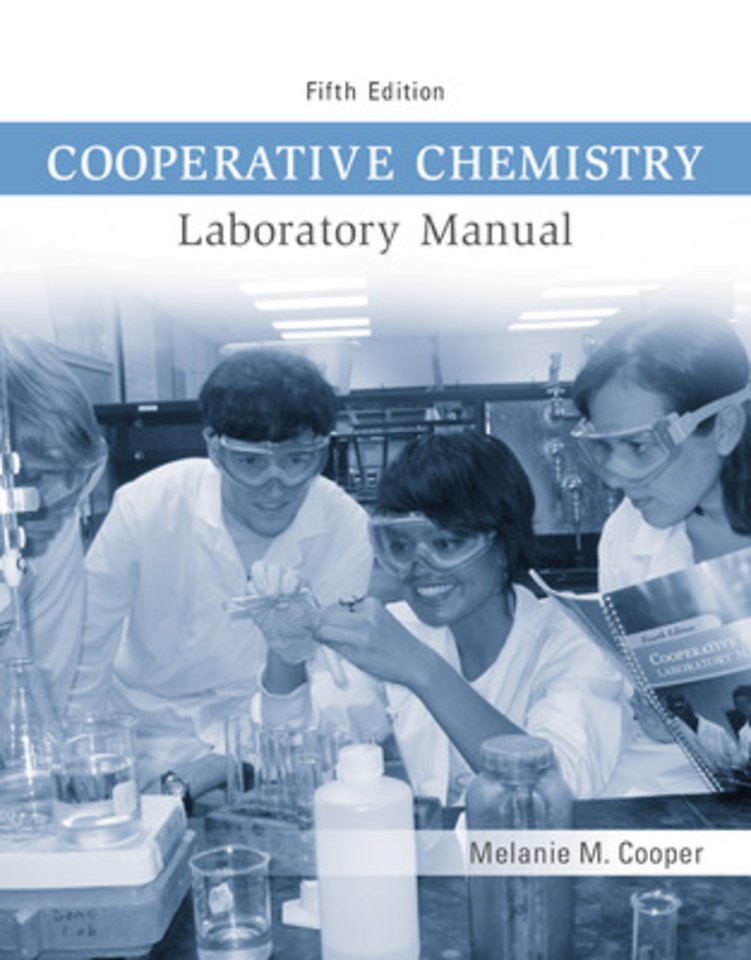
Melanie Cooper
McGraw-Hill Education
5e druk, 2011
9780073402727
Cooperative Chemistry Lab Manual
Specificaties
Ringband, blz.
|
Engels
McGraw-Hill Education |
5e druk, 2011
ISBN13: 9780073402727
Rubricering
Levertijd ongeveer 10 werkdagen
Samenvatting
The laboratory course described in the lab manual emphasizes experimental design, data analysis, and problem solving. Inherent in the design is the emphasis on communication skills, both written and oral. Students work in groups on open-ended projects in which they are given an initial scenario and then asked to investigate a problem. There are no formalized instructions and students must plan and carry out their own investigations.
Specificaties
Inhoudsopgave
<h2>Section 1: Cooperative Chemistry: How and Why<h4>Cooperative Chemistry Laboratories<h5>To the Instructor<h5>To the Student<h5>A Word About the Things You will Learn in This Course Besides Chemistry<h4>Cooperative Learning<h4>Conflict Management<h4>Nature of the Course<h4>Brief Outline of the Course<h4>Resources<h4>Safety Rules<h4>Basic Laboratory Etiquette<h4>NFPA Hazard Codes<h4>Waste Disposal<h4>Material Safety Data Sheets (MSDSs)<h4>Recording and Reporting Results<h5>The Laboratory Notebook<h5>Writing Lab Reports<h5>Preliminary Report Guidelines<h5>The Science Writing Heuristic<h5>Reporting Numerical Results<h5>Graphing Data<h5>Oral Presentations<h2>Section 2: Laboratory Equipment<h4>Containers<h5>Test Tubes<h5>Beaker<h5>Erlenmeyer Flasks<h5>Microscale Cell Wells<h5>Evaporating Dish<h5>Crubible and Lid<h5>Watch Glass<h5>Ignition Tube<h4>Measuring Devices<h5>Measuring Liquids by Volume<h5>Measuring Solids and Liquids by Mass<h4>Transfer Devices<h5>Droppers and Pipets<h5>Funnels<h5>Tongs<h5>Test-Tube Holder<h5>Forceps<h5>Spatulas<h4>Support Devices<h5>Metal Ring<h5>Pipestem Triangle<h5>Wire Gauze<h5>Clamps and Clamp Holders/Universal Clamp<h4>Heating Devices<h5>Bunsen Burner<h5>Heating Bath<h2>Section 3: Laboratory Techniques<h4>Preparing an Experiment<h4>Dealing With Unknown Compounds<h5>Preliminary Tests<h5>Smell<h5>Physical State<h4>Solubility Tests<h5>Qualitative Testing<h5>Quantitative Testing<h4>Analysis of Anions<h4>Analysis of Cations<h5>Test for Ammonium (NH4+)<h5>Flame Tests<h4>Microscale Techniques<h4>Solution Techniques<h5>To Make up a Solution of Known Concentration<h5>Dilution of Solutions<h5>Preparing and Using a Volumetric Pipet<h5>Preparing and Using a Buret<h5>Titration<h5>Reading a Meniscus<h5>Titration Procedure<h4>Filtration<h5>Gravity Filtration<h5>Vacuum Filtration<h4>Chromatography<h5>Thin Layer Chromatography Procedure<h4>Precipitation (Gravimetric Analysis) for a Solution of a Known Salt of Unknown Concentration<h4>Precipitation (Gravimetric Analysis) of a Solid Unknow Salt<h4>Boiling Points/Melting Points<h4>Separation of Liquids<h4>Sepatation of Mixtures of Solids<h4>Recrystallization<h4>Organic Chemistry<h5>Organic Functional Group Tests<h2>Section 4: Laboratory Instruments and Spectroscopy<h4>Spectroscopy<h5>Nuclear Magnetic Resonance<h5>Infrared Spectroscopy<h4>Color and Spectroscopy<h5>The Units of Color Intensity<h5>The Relationship Between Absorbance and Concentration<h4>pH Meter—Its Care and Use<h5>The pH Meter as a Voltmeter<h5>The Multimeter as a Voltmeter<h5>Conductivity Meter<h5>The Multimeter as a Conductivity Meter<h2>Section 5: Projects<h4>Project 1: Density<h4>Project 2: Investigation of Chemiluminescence<h4>Project 3: Concrete<h4>Project 4: Finding the Relationship Between the Volume of a Gas and the Temperature<h4>Project 5: Designing a Calcium Supplement<h4>Project 6: Properties of Matter and Separations<h4>Project 7: Acids and Bases<h4>Project 8: Buffers<h4>Project 9: White Powders<h4>Project 10: Electrochemistry<h4>Project 11: Identification, Properties and Synthesis of an Unknown Ionic Compound<h4>Project 12: Hot and Cold<h4>Project 13: Analysis of Colas<h4>Project 14: Identification, Properties and Synthesis of an Unknow Organic Compound<h4>Project 15: What Affects the Rate of a Reaction?<h4>Project 16:Investigation of Kidney Stones: Formation and Dissolution<h4>Project 17:Soaps and Detergents<h2>Glossary<h2>Index